Monday, October 26, 2009

Beef Dip

Beef Dip

Beef Dip is a hearty and delicious dish that’s perfect for gatherings, weeknight dinners, or whenever you’re craving tender roast beef with savory dipping sauce. The secret? A humble package of onion soup mix adds incredible flavor with minimal effort. (Shh...don't tell the chefs at Le Cordon Bleu! They would want you to make French Onion Soup from scratch and dehydrate it yourself!)

Serve with crusty French bread for the ultimate comfort meal.

Recipe: Beef Dip

from Auntie Joyce

Serves: 8

Ingredients:

4-pound beef roast
1 teaspoon dry mustard
½ teaspoon dried oregano
Salt and freshly ground black pepper
2 tablespoons vegetable oil
2 yellow onions, cut into slices or rings
5 cups water
½ cup soya sauce
1 package onion soup mix
1 garlic clove, minced

Insructions:

To Prepare and Eat Now:

  1. Preheat your oven to 325°F (163°C).
  2. Pat the roast dry with paper towels. Rub or sprinkle it with dry mustard, oregano, salt, and pepper.
  3. In a large roasting pan, heat vegetable oil over medium-high heat. Sear the roast on all sides until browned. Set aside.
  4. Add sliced onions to the roasting pan and sauté until tender, about 10 minutes.
  5. Pour in water, soy sauce, onion soup mix, and minced garlic. Stir to combine. Return the roast to the pan.
  6. Roast in the oven for 2-2½ hours or until the beef reaches your desired doneness:

    Extra-rare (bleu)115-120°F (46-49°C)
    Rare125-130°F (52-55°C)
    Medium rare130-140°F (55-60°C)
    Medium140-150°F (60-65°C)
    Medium well150-155°F (65-69°C)
    Well done>160°F (>71°C)

To Freeze:

  1. Cook the roast to a slightly lower temperature than desired, allowing it to finish cooking when reheated.
  2. Slice the beef and layer it between sheets of wax paper.
  3. Freeze the roast and sauce in separate containers. Recommended freezing time: 6-12 months.

To Prepare After Freezing:

  1. Thaw overnight in the refrigerator.
  2. Reheat the beef slices and sauce in the microwave or on the stovetop.
Beef Dip


Thursday, October 22, 2009

Week 5 at Le Cordon Bleu (Basic Cuisine)

Time is flying by so fast here at Le Cordon Bleu. Week 5 seems long ago and was all about soups and compound butters. Well, "soup" is not the right term; "potage" is more accurate. Soup, a type of potage, is derived from the word souper, which means to absorb. To be called a soup, it must contain bread (such as French Onion Soup or Fish Soup). A potage is either thickened (called a lié) or unthickened (clair), such as consommé.


Thursday, October 15, 2009

Orange Pumpkin Loaf

Orange Pumpkin Loaf

This Orange Pumpkin Loaf combines the warmth of pumpkin with the bright, zesty taste of whole orange, peel and all! A recipe straight from the professional kitchens of Le Cordon Bleu, this loaf is packed with seasonal spices, walnuts, and raisins, making it a delightful treat for breakfast, tea time, or dessert.  I was in the kitchen at Le Cordon Bleu to practice filleting a Dover Sole and turning mushrooms, and Chef shared a pumpkin loaf with me. It was so delicious, I asked for the recipe.

It uses a whole orange, making it extra flavorful and perfect for this Fall season. Enjoy!


Thursday, October 8, 2009

Week 4 at Le Cordon Bleu (Basic Cuisine)

Taste, turning, trussing, and tears.

Last week, we had a seminar on taste! Spending a morning talking about taste was pretty cool! In many little white tubs, lined up in rows, were a variety of different colored liquids. In groups, we were given a container and asked to think of a memory that went along with it. Unfortunately, many of the tubs contained slightly stale versions of the originals, and too often Grandma's lace or even, in some cases, urinal pucks came to mind! Here's what we had to guess: white balsamic vinegar, lavender, truffle, shrimp paste, bergamot, lime, hazelnuts, sesame oil, anise-flavored alcohol, hoisin sauce, cognac, soy sauce, fish sauce, vanilla, port, rum calvados, pear alcohol, tabasco, chili paste. I found it challenging to deconstruct the aromas, but it was fun.

The next demo was all about Les Fonds Blanc et Brun (Brown and White Stocks), the base of sauces in French cuisine. We covered chicken stock, veal stock, tomato sauce (one of the mother sauces), and fish fumet. Our practical was to fillet a whole Dover sole, use the bones to make a fish fumet, and finish with a dish called Filet de sole de Douvres Dieppoise. This dish must include mussels and shrimp to be called Dieppoise. Not a problem. I've cooked mussels before and the shrimp came pre-cooked. However, the whole Dover sole slowed me down. It was the maiden voyage for my filleting knife and my hands with a whole fish. My filleting needed practice, so I attended an extra practice the next day and bought some frozen ones from the local fishmonger. I can happily say that I now know how to fillet a flatfish. I can't say that about turning mushrooms. Even after turning pounds of mushrooms that night, my mushrooms are more "carved" than "turned".

Here are some of the dishes the chef made during the demo.
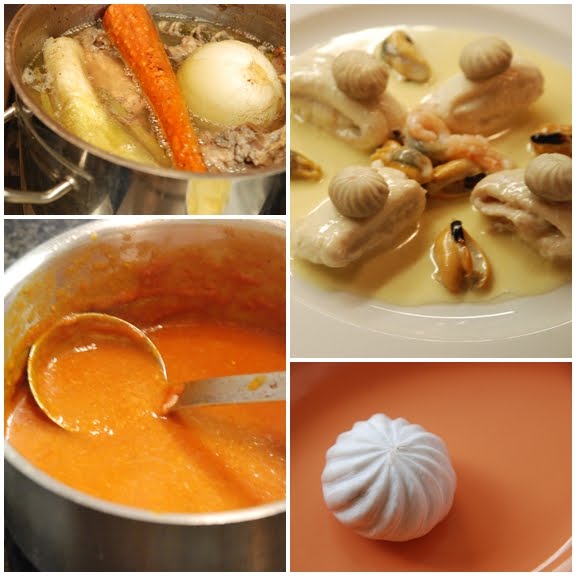

Clockwise from top: Chef’s Fond blanc de volaille (Basic recipe for white stock)
Filets de sole Dieppoise (Sole fillet served with a white wine sauce)
Turned mushroom
Sauce tomate (Tomato sauce)

The next demo discussed two more mother sauces (Espagnole and Béchamel) and their derivatives (demi-glace, Sauce Crème, Sauce Mornay, and Sauce Soubise). Trouble came when it was time to truss the chicken during the practical. It looks easy enough. Cut wing tips. Dig out the wishbone. String needle. Poke through cartilage in one leg, through the other leg, flip, through two bones of one wing, under neck, through two bones of the other wing, and tie. With the leftover string, thread through cartilage in one leg, through the pope's nose, and through cartilage in the other leg and tie the legs together. Tuck wings under. Not so hard. But it was for me. After three tries and each time, the chef shook his head saying "Do it again" in his stern, French accent, tears started to fall. I knew this would happen, but I thought it would be over a burnt sauce or charred meat, not over a simple truss. Meanwhile, the other students were getting their chicken broth cooking, but I was still bent over my string with salty tears brining my naked bird. Finally, I plopped my tear-stained and weakly tied bird into the pot and hid it with water hoping I could catch up. Unfortunately, I also seemed to pick the station where the flame kept going out under my pot. This bird did not want to get cooked.

I made my roux and checked it with the chef who with a slight air said I'd added a touch too much butter for the amount of flour. Then, it was onto the rice pilaf. The onions had to be cut in ciseler fashion and were to be the size of a grain of rice. Some were; some weren't. I sweat the onions in butter making sure they didn't acquire any color, then added the rice and cooked until nacré (a pearl color!). A bit of salt, a bouquet garni, the right amount of water, and a lid of parchment paper, and into the oven for exactly 17 minutes.

Back to the chicken. Checking it confirmed my fears: it wasn't cooked yet. And for some reason, I didn't think to remove some of the broth to reduce separately for the sauce. I turned my attention to the roux and mistakenly added the cream before adding the broth, ruining both in the process! This was not my day. So, I was back to making a new batch of roux. I quickly measured 30 grams of flour and butter and hastily set about to cooking it to the required blond, nutty color. By this time, I had the forethought to put some broth in a separate pot to reduce. When the roux was ready, so was my broth. I added it to my roux, thickened the mixture, and let it cook for as long as possible before adding the cream. Everything else came together. My sauce was à la nappe, coating the chicken, my bird was cooked just right (not a second more), and my rice was done with the odd large piece of onion thrown in. And the tears buried in my chicken earlier made it taste even better.

Here are two of the dishes the chef made during the demo.


Chef’s Sauce Espagnole and
Poulet poché sauce Suprême (Whole poached chicken served with a white creamy sauce)

The final demo last week was about emulsion sauces including hollandaise and Béarnaise. I love these two rich sauces. The first step in the Béarnaise is a reduction. Easy enough, but you need enough liquid after the reduction to make the sabayon. For the sabayon, which contains two yolks, you need two half-egg shells full of liquid. I thought I had enough, but it became apparent while whisking my sabayon that I was lacking a few drops! The chef came over, frowned, went to the sink dribbled a few more drops of water expertly in my bowl, and warned that it might break on me in no time flat. I whisked and whisked and whisked. Although it never broke, it was a little thick. Again, when the chef came over, and saw me whisking in the clarified butter on the "cold" side of the station, he grimaced and suggested I move to the stove side, again warning that my sauce would break and that it was saturated with butter! Funny because I had started clarifying more butter since I didn't have as much as the recipe called for. We also had to turn some potatoes à l'Anglaise (a specific size that is three fingers long) and grill some salmon. Again, I finished on time, but a critique of my plate was all critique. School is tough, but I'm learning a ton, even through my tears.

Here are some of the dishes the chef made during the demo.
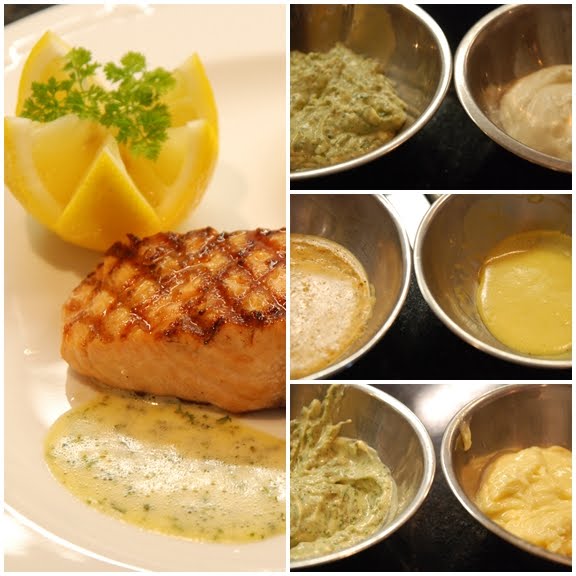

Clockwise from top: Chef’s Saumon Grillé, sauce Béarnaise (Grilled Salmon with Béarnaise Sauce)
Sauce Rémoulade (Sauce derived from Mayonnaise) & Hollandaise
Sauce Tyrolienne (Béarnaise sauce made with oil) & Sauce Moutarde (Sauce derived from Hollandaise)
Sauce Grebiche (Emulsified cold sauce based on cooked egg yolk) & Mayonnaise

. . . . . . . . . .

Here is a link back to the recipes as I did them last year (although they aren't exactly the same as what we did in class):

Class 10: Les Fonds Blanc et Brun (Brown and White Stocks)
Fumet de poisson (Fish stock)
Filets de sole Dieppoise (Sole fillet served with a white wine sauce)
Fond blanc de volaille (Basic recipe for white stock)
Fond brun clair de veau (Basic recipe for brown stock)
Sauce tomate (Tomato sauce)

Class 11: Les Sauces et Liaisons (Mother Sauces and Liaisons)
Poulet poché sauce Suprême (Whole poached chicken served with a white creamy sauce)
Sauce Espagnole and Demi-glace (Basic brown sauces)
Sauce Béchamel (White sauce): Crème, Mornay, and Soubise

Class 12: Les emulsions (Emulsion sauces)
Sauce Hollandaise (Warm emulsified sauce) and Sauce Moutarde
Sauce Béarnaise (Warm emulsified sauce derived from Hollandaise sauce)
Sauce Mayonnaise (Basic emulsified sauce) and Salade Messidor (Summer Harvest Salad)





Wednesday, October 7, 2009

Whisk Wednesdays—Beignets aux Pommes, Sauce Abricot (Apple Fritters with Apricot Sauce)


Beignets aux Pommes, Sauce Abricot (Apple Fritters with Apricot Sauce)This recipe completes my goal of working through the Basic Cuisine curriculum on my own, in my own kitchen. I started my blog as a way of documenting my progress working through this Le Cordon Bleu curriculum, not knowing that I'd actually be attending 20 months later!


Thursday, October 1, 2009

Fresh Pasta

Fresh PastaOne of my favorite kitchen gadgets is my KitchenAid Stand Mixer (affiliate link). I’ve thrown some tough dough its way and it has yet to fail me. Recently, I was pleased to receive the pasta attachment as a gift. The KitchenAid Companions Gourmet Pasta Kit came with the following items:

• a metal pasta roller
• a metal fettuccine cutter
• a pasta server and slotted spoon
• two boxes of Ecco La Pasta flour (egg and spinach)
• a cleaning brush

The timing of this gift was fantastic since we had just covered fresh pasta dough in Lesson 6 at Le Cordon Bleu and practicing making pasta at home was the perfect way to test out this attachment.

Now, in the Basic Cuisine course, no kitchen machinery is allowed and all work must be done by hand to develop a sense for the feel of the dough at various stages. So I decided it would be fun to do a "bake off" so to speak: half of the pasta I hand rolled and cut and the other half I made using the mixer attachment. As an extra experiment, I made one batch with just yolks (and added extra water) and the other with whole eggs. The chef had suggested we try this to see if we preferred one dough over the other.

Using the attachment was twice as fast as without. Within the hour, I had fresh pasta ready for lunch. Not only that but it was easy enough to use that my 10-year-old daughter quickly figured it out and had fun putting the dough through, each time moving the dial to a thinner setting appropriate for fettucini. Hand rolling took a lot of effort, but eventually, after much rolling, I rolled it to the proper thickness. My daughter found it difficult to get it thin enough, so I helped her. Even so, our dough was uneven and squaring it off to cut even lengths meant re-rolling. Though not impossible to hand roll, we both preferred the attachment, which makes pasta making a breeze.

As far as the eggs are concerned, no one could taste a difference between the two so I would use whole eggs next time, just for the sake of convenience.

All in all, we're looking forward to making more pasta and using the roller to make lasagna noodles (a family favorite). Clean-up was also easy! My daughter just wiped it with a cloth and used the small brush to get any bits out. She was so pleased with her homemade pasta that she took it to school the next day in her lunch. With this pasta-making attachment, I'll be making homemade pasta often! Or maybe my daughter will be making it for me!

Recipe: Fresh Pasta

Serves: 6

Fresh Pasta ingredients

Ingredients:

250 grams flour
5 grams salt
10 ml olive oil (you may need more)
2 eggs
10 ml cold water

Instructions:

1. Prepare the Dough:

  • Sift the flour onto a clean countertop. Whisk in the salt. Create a well in the center.
  • Add olive oil, eggs, and water into the well. Using your fingers, gradually mix the wet ingredients while slowly incorporating the surrounding flour to form a paste.
  • Once the mixture becomes crumbly, use a pastry scraper to gather and knead it into a smooth dough. Add extra olive oil or water if the dough feels dry.

2. Rest the Dough:

  • Wrap the dough in plastic wrap and let it rest in the refrigerator for 20 minutes. This step ensures elasticity and easier rolling.

3. Rolling the Dough:

  • By Hand: Roll the dough to a 1–2 mm thickness with a rolling pin. Square the edges with a knife, then fold the dough into even layers (approximately 5 cm wide). Slice into fettuccine strips and dust with flour to prevent sticking.
  • Using KitchenAid Attachment: Attach the pasta roller and start at the widest setting. Pass the dough through, folding it in half and repeating until smooth. Gradually reduce the roller thickness to the desired setting. Use the fettuccine cutter attachment for even strips.

4. Cooking the Pasta:

  • Boil a large pot of salted water. Cook the pasta for 3–5 minutes, or until al dente. Drain and serve immediately with your favorite sauce.

Tasting Notes
Freshly made pasta offers a soft, silky texture that elevates any dish. Whether hand-rolled or made with a KitchenAid attachment, the difference in flavor and quality is unmistakable. Pair with a classic tomato sauce or creamy Alfredo for a satisfying meal.

More to Explore:


Wednesday, September 30, 2009

Whisk Wednesdays—Carre d'Agneau (Rack of Lamb)

This rack of lamb, a signature French recipe that’s both elegant and delicious, is the second-last recipe as part of the Basic Cuisine curriculum that I've been following. The hardest part is preparing the rack. Watch this video to see how to "French" a rack of lamb. Then, it's just a matter of searing the meat and vegetables and finishing it in the oven. The sauce is made from the pan juices and water, seasoned with salt and pepper. Not too many dishes this time either!


Tuesday, September 29, 2009

Week 3 at Le Cordon Bleu (Basic Cuisine)

After last week, I was glad to leave the white pepper on the shelf for a bit. During week 3 at Le Cordon Bleu, we turned our attention to desserts. Crème anglaise and charlotte were the first tests of our dessert skills. These desserts are light, called "entremets", which translates to "between meals".

The first practical had us making old-fashioned apple charlotte. Fourteen students were cooking down the apples slowly, caramelizing them only after they were cooked, and the aroma was heavenly. We all lined the charlotte molds with bread, first cutting the bottom pieces into raindrop shapes to form a circle. Lastly, we made crème anglaise to a thickness called à la nappe. Everything was going along perfectly until the unmolding stage when I forgot to trim the excess length of my bread pieces, which in turn caused the apple compote inside to travel to meet the plate making the whole thing fall apart slightly. One miss-step in the kitchen, and everything is quickly ruined (except in this case it still tasted sweet)!

Here are the desserts the chef made during the demo.


Clockwise from top: Chef’s Poires au vin rouge (Pears cooked in red wine)
Crème renversée au caramel (Reversed caramel cream or Crème caramel)
Charlotte aux pommes, crème anglaise au Calvados (Apple Charlotte served with Calvados custard sauce)
Sabayon aux fruits (Fruit Zabaglione)

The next day was all about frozen desserts: ice creams, glace, granité, sorbet, and frozen soufflé. During the practical, we made frozen orange soufflé and tuiles. The soufflé is composed of whipped cream, Italian meringue and sabayon all made by hand using only a whisk. Click click click. Whisks were dancing in the bowls.

First up was the whipped cream. Next was the meringue where the trick was to get the sugar syrup to the soft ball stage (without a thermometer) at the same time that the egg whites were at the soft-peak stage and ready to accept the sugar syrup. Since we weren't allowed to use thermometers for the sugar syrup, we had to get a bowl of ice water ready to dip our fingers in before dipping into the 235°F syrup! Although a little scary, we all did it and now know what soft ball feels like. Meringue is like a Dairy Queen blizzard. Once you've slowly added the hot sugar syrup to the egg whites and whisked until it's cooled to room temperature, you should be able to flip the bowl upside down without any of the mixture falling out.

The next component was the sabayon. Only two ingredients (yolks and orange juice) form one of the most magical sauces you can make. The trick is in the whisking and the heat. Over a simmering water bath, you whisk and whisk and whisk some more. Never stopping in case it falls. About fifteen minutes later, you have a thick, rich, sweet sauce that you must whisk even more off heat just to cool off before folding in with the meringue and whipped cream. At least there's some exercise in the kitchen!

Here are the desserts the chef made during the demo.


Clockwise from top: Chef’s Crème glacée vanilla (Vanilla ice cream) and Glace au café (Coffee ice cream)
Soufflé glacé à l'orange (Deep-frozen orange soufflé) with Cigarettes aux amandes (Tubular almond biscuits)
Granité au Calvados (Calvados sorbet)
Candied Orange Slices

The last class was about salads and during the practical we made Niçoise salad. Parts of the salad needed to be cooked (potatoes, eggs, and green beans) and cooled. The rest of the ingredients just needed to be chopped uniformly. Finally, we made a simple vinaigrette to serve with it.

The trickiest part was cooking the eggs to the perfect point. We were told to bring water to a boil, put a room temperature egg in for 10 minutes ensuring it was covered with boiling water. If the egg was fridge temperature, it needed to stay in the boiling water for 12 minutes. I chose to leave mine in for 11 minutes since it was in-between room and fridge temperature. When my timer beeped, I pulled it out and set it under cool, running water for several minutes. Unfortunately, my egg was very slightly under-cooked, according to the chef's masterful eye. As well, my potatoes were too cold and hidden on the plate. Otherwise, taste-wise all was good and well-cooked.

Here are the salads the chef made during the demo.


Clockwise from top: Chef’s Salade Niçoise (Vegetable salad Provençale, garnished with tuna, anchovies and egg)
Frisée aux lardons (Warm chicory with bacon)
Salade Francillon (Potato and mussel salad)
Salade des nonnes (Rice salad with truffled chicken)

Well, that was week 3 at Le Cordon Bleu. I enjoyed preparing some desserts this week, but I'm looking forward to getting back to the fundamentals of cuisine next week.

Tools you must have in your kitchen: a whisk and an ice cream maker
Tools you don't need: a candy thermometer

. . . . . . . . . .

Here is a link back to the recipes as I did them last year (although they aren't exactly the same as what we did in class):

Class 7: Les Entremets (Basic Desserts)
Part 1 - Charlotte aux pommes, crème anglaise au Calvados (Apple Charlotte served with Calvados custard sauce)
Part 2 - Crème renversée au caramel (Reversed caramel cream or Crème caramel)
Part 3 - Poires au vin rouge (Pears cooked in red wine)
Part 4 - Pruneaux au vin blanc (Prunes cooked in white wine)
Part 5 - Sabayon aux fruits (Fruit Zabaglione)

Class 8: Les Entremets Glacés (Frozen Desserts)
Part 1 - Cigarettes aux amandes (Tubular almond biscuits) with Crème glacée vanilla (Vanilla ice cream) and Glace au café (Coffee ice cream)
Part 2 - (Granité au Calvados (Calvados sorbet)
Part 3 - Sorbet au citron vert (Lime sorbet)
Part 4 - Soufflé glacé à l'orange (Deep-frozen orange soufflé)

Class 9: Les Salades (Salads)
Part 1 - Frisée aux lardons (Warm chicory with bacon)
Part 2 - Salade Niçoise (Vegetable salad Provençale, garnished with tuna, anchovies and egg)
Part 3 - Salade des nonnes (Rice salad with truffled chicken)

Part 4 - Salade Francillon (Potato and mussel salad)


Wednesday, September 23, 2009

Whisk Wednesdays—Pets de Nonnes (Choux Pastry Fritters with Apricot Sauce)

Pets de Nonnes (Choux Pastry Fritters with Apricot Sauce)This recipe, literally translated, means "nun's farts"! Choux pastry is deep-fried and sprinkled with confectioners' sugar much like a doughnut. The story is that a nun accidentally dropped a ball of choux paste into a kettle of hot oil. Instead of throwing it out, the nun watched the choux paste bubble and brown and upon tasting it named it Pets de Nonnes.


Tuesday, September 22, 2009

Week 2 at Le Cordon Bleu (Basic Cuisine)


Clockwise from top: Chef’s Flamiche aux maroilles et poireaux (Leek tart from northern France),
Pâté Pantin (Pork pie without use of mould),
Getting Ready to Taste

Week 2 at Le Cordon Bleu was full of flour, fraisage, and finger injuries.

I’m thoroughly enjoying the demos. It’s almost as if the secrets of the culinary world are being whispered in our ears, passed down to the next generation as grandparents would for their grandchildren. The demos are full of helpful tips that are best shown live: watching the chef make pâte brisée, showing us how to flour our tables (fleurer), how to gently work in the flour without over-mixing the dough, and demonstrating the technique of fraisage where you take just a bit of dough and rub it between your palm and the marble countertop to form a dough, repeating this for all the dough. Although I’d read about fraisage before, to watch it makes more sense. And I was surprised by the texture of the quiche that the chef served us. It was more like custard with salt, cheese and lardons (we’re not allowed to use the word bacon!) and less like scrambled eggs.


Thursday, September 17, 2009

Feast of Fields—Ballotin of Ferme aux Saveurs des Monts Organic Chicken

Feast of Fields was an Ottawa event held this past weekend that brought together the talents of organic farmers and chefs and allowed hungry guests to sample all their tasty treats. Chefs were paired with area farmers to showcase this season's harvest. And what a feast it was!

There were 25 teams set up with tables along each side of a huge tent. The weather was perfect, with a slight cool breeze, and the diners were clamoring to get their plate and sample the local organic food. As we walked around tasting, we were amazed by the variety of options. From mini bites of cornbread and smoked pork and apple sausage to goose terrine garnished with a delicate edible flower and gingersnap cookies, I soon realized my eyes were bigger than my stomach.

The winner of the Best Farmer-Chef Team was Sylvain Bertrand of Ferme aux Saveurs des Monts and Executive Chef Serge Jost and Executive Sous Chef Timothy Wasylko from Fairmont Le Château Montebello.

This team set the bar very high for upcoming Feasts. With a pastry brush, they painted the bottom of each plate with port wine caramel. Then they carefully assembled each part of the dish starting with the rolled slice of chicken, followed by the apple ginger compote, some micro greens for color, and a Balsamic Tuile carefully placed on top. It was a work of mouth-watering art showcasing the best of local and organic ingredients in one dish.


Clockwise from top:
Executive Sous Chef Timothy Wasylko, Executive Chef Serge Jost,
Ballotin of Ferme aux Saveurs des Monts Organic Chicken,
Winning Team #11

I had a chance to talk to Executive Sous Chef Timothy Wasylko during the event, and after telling him about my recent events at the cooking school, he provided some well-needed tips about how to turn vegetables! I asked if they use turned vegetables that much at Fairmont Le Chateau Montebello, and sadly he said “sometimes”. His tips included using an egg to practice dragging a knife along the outside to get the muscle memory of turning into your hands. He also suggested dipping the egg in wax, which is a great idea! Later in the week, I contacted the chefs to ask if they would like to share their winning recipe, and they were happy to. Thank you!

Recipe: Ballotin of Ferme aux Saveurs des Monts Organic Chicken
with roasted pumpkin, sundried cranberries and pine nuts, apple compote and port wine caramel

from Fairmont Le Chateau Montebello Executive Chef Serge Jost and Executive Sous Chef Timothy Wasylko

Serves: 6-8

Ingredients:

1 whole organic chicken, deboned
1 breast of organic chicken
200 g pumpkin
3 teaspoons organic extra virgin olive oil
2 organic egg whites
100 ml organic 35% cream
Salt and pepper
1 g cinnamon
1 g ground clove
1 g ground ginger
1 g ground nutmeg
4 organic cloves of garlic, roasted
3 organic onions, sliced and cooked until well caramelized, then cooled
6 large leaves of Swiss chard
10 g pine nuts, toasted until golden brown
10 g sundried organic cranberries

Instructions:

Preheat oven to 350°F. Drizzle pumpkin with olive oil and season with salt and pepper. Roast for 45 minutes or until very soft, allow to cool. In a food processor, purée pumpkin and chicken breast until smooth. Add egg whites, cream, spices, roasted garlic, and caramelized onions. Season with salt and pepper. (Cook a small amount to taste seasoning.)

Blanch Swiss chard in boiling water for 30 seconds and immediately submerge into ice water. Remove and dry very well.

Stuffing is basically like making sushi. Using a sushi mat lined with plastic wrap- first spread the Swiss chard so it is an even thin layer. Spread 4 tablespoons of pumpkin mixture completely over the surface of the Swiss chard. Sprinkle with pine nuts and dried cranberries. Gently roll as tight as possible and wrap in plastic wrap. Refrigerate.

Place deboned whole chicken skin side down. Cut in ½ lengthwise between the breasts. Cover with plastic wrap and pound until meat is thin and completely covers the skin. Season with salt and pepper. Spread 3 tablespoons of pumpkin mixture completely over chicken. Place Swiss chard roll in the center and roll up chicken with skin on the outside. Wrap very tightly in plastic wrap. Continue with the other ½ of the chicken. Poach in water for 25 minutes. Then allow to cool. Remove plastic and roast in a 400°F oven for approximately 35 minutes or until the internal temperature is 165°F (74°C.)

Apple Ginger Compote
2 organic Apples, peeled and cut into wedges
10 ml Japanese white pickled ginger, finely chopped
10 g organic butter

Cook apples in butter until soft. Add ginger.

Balsamic Tuile
30 ml balsamic vinegar
30 ml organic sugar
10 ml butter
40ml flour

Preheat oven to 350°F. Mix all ingredients together. Pour into the desired shape on a Silpat-lined sheet pan. Bake until lightly browned, about 10 minutes.

Port Wine Caramel
750 ml port wine

Boil port wine and allow to reduce until 100 ml, about 20 minutes.

To Assemble
Paint port wine on the plate. Top with a slice of ballotin. Add 15 ml compote and garnish with the Tuile and a little bit of micro greens.

. . . . . . . . . .

Here are some other notable tables at Feast of Fields that I enjoyed...


Clockwise from top:
Potato and Leek Soup,
Arctic Char Bruschetta,
Cherry Tomatoes,
Carrot and Beet Salad

The Red Apron & Sweet Meadow Farms
A creamy potato and leek soup was being served by Jennifer and Jo-Ann of The Red Apron with heirloom potatoes from Sweet Meadow Farms. The display of the many varieties of potatoes by Sweet Meadow Farms was awe-inspiring. Red Apron’s arctic char on a crispy herb biscuit was another delightful bite.

Epicuria & Bryson Farms
Tracey Black from Epicuria was paired up with Bryson Farms and served a beautiful vegetable medley of carrots and beets drizzled with a citrus vinaigrette. It was almost too pretty to eat.


Clockwise from top:
Smoked Pork and Apple Sausage,
Grilled Bison and Cucumber Mint Salad,
Beau’s Beer,
Pascale’s All Natural Ice Cream

Thyme and Again Catering & Ashton Naturals
Thyme and Again Catering served smoked pork and apple sausage in little bamboo boats. The bun that the sausage was served in was a favorite part of this serving with its seeds and wholesome taste.

Sweetgrass Aboriginal Bistro & Battle River Bison Co.
Warren Sutherland from Sweetgrass Aboriginal Bistro along with Battle River Bison Co. dished out a grilled bison and cucumber mint salad with a sesame dressing that was a refreshingly crunchy mixture of vegetables. The Asian-inspired vinaigrette surrounding each bite made for a perfect salad.

Beau’s All Natural Beer
Everyone was enjoying the beer from Beau’s, voted Best Craft Brewery in Ontario. Their beer is golden, crisp and finely balanced and deserves all the awards they’ve been receiving.

Pascale’s All Natural Ice Cream & The Pickle Patch
For the whole afternoon, Pascale was dishing up her All Natural ice cream, and the line never stopped growing. We enjoyed tasting Peanut Butter Pickle, Sour Cream Strawberry, and Beau’s Chocolate. All were creamy and refreshing.


It was a fine feast to celebrate the end of summer!


Wednesday, September 16, 2009

Whisk Wednesdays—Grenadins de Veau au Coulis de Celeri-Rave (Veal with Celery Root Cream Sauce)

Grenadins de Veau au Coulis de Celeri-Rave (Veal with Celery Root Cream Sauce)
It seems these last recipes in the curriculum are strictly a review of techniques already learned. They don't contain much history or interest but are good practice for the impending exam. Grenadins de veau are thick veal fillet steaks laced with pork fat. After sprinkling the meat with salt and pepper and searing them on the stove in a bit of butter, I placed (I should have larded!) the pork fat on top of the veal and set it aside while I worked on the vegetables.


Tuesday, September 15, 2009

Week 1 at Le Cordon Bleu (Basic Cuisine)

The anticipation of the students waiting before the first demo was tangible. A little nervous chatter here and there, but mostly silence.

WaitingAt last, we were invited into the elegant yellow and white room with high-tech flat panel screens on either side. Everyone tried to score a front row seat.

The chef explained many things including the kitchen brigade, all the different knives and tools in the kit (worth about $1000 Canadian but is included in the tuition), safety and hygiene tips, and French terms for all the pots, pans and tools.

Then he launched into vegetable cuts, including émincer, ciseler, hasher, julienne, brunoise, paysanne and chiffonade. Finally, he made Potage cultivateur (Cut vegetable soup).

In the kitchen, we had a chance to practice our precision cuts with carrots, turnips, potatoes, onions, leeks and cabbage. Lot of practice is required for the precision required at Le Cordon Bleu. I have a long way to go (and wondering if I'm on the right path)!

Potage cultivateur (Cut vegetable soup)
Chef's Potage cultivateur


Lesson three was all about garnitures (not garnishes!), which are side dishes. It was fun to see the master chef work on so many dishes (six of them) at once without breaking a sweat while we kept flipping pages to keep up with which recipe he was working on.

Knowing we had to make three dishes during the practical was daunting enough for me: Bouquetière (a hot garniture of turned vegetables and artichoke), Jardinière (another hot garniture of vegetables cut as batonnets), and finally Macédoine (a cold vegetable medley cut into small cubes or pieces). In addition to these recipes, chef made Tomates
concassées, Portugaise, Duxelle sêche de champignons, Blanc de cuisson, Grandmère and showed us the different cuts for Pommes de terre pour frire.

Since there are 30 students in Basic Cuisine, we've been broken up into two groups of 15 for the kitchen part of our class. Our group has already experienced its share of drama.

In the third practical (our second one where we actually had to use the stoves), one student sliced her finger and while the chef was cleaning her cut, she fainted. We were all asked to leave the room, and wait in the lounge while they helped her. Meanwhile, an ambulance was called to ensure she was ok. She came back to class shortly after that and was ready to resume her station. However, we still had to serve the chef our dishes at the same time agreed upon at the beginning of class. That was stressful, but the show must go on!

Artichokes have always confounded me. I've never known how to prepare them. Well, now I've prepared them twice in the last week, and I've learned that I like them! The day before we were shown how to turn artichokes and cook them in a Blanc de Cuisson (a mixture of water, flour, lemon and salt). We practiced this again in the third practical. Although I failed to remove the entire choke for serving, I now know that I can buy an artichoke at the grocery store, and I finally understand what to do with it.

I also learned that it's important to keep the stove from being idle. While turning turnips, I had to cook carrots. While cooking turnips, I had to prepare green beans. It's about making the most of the time you have and multitasking. It's also about having the skill to turn vegetables quickly. Even after spending hours on a Saturday night practicing turning vegetables with my husband (who was much better at it than me, by the way!), I'm still impossibly slow and awkward shaping turnips and carrots into pretty footballs (if footballs can be pretty!).

But during this practical, I started to feel like I can actually do this. In someone else's kitchen. With someone watching over every move looking for ways to help us improve. There's chaos all around with students asking which is the parsley, others asking where to find the cutting boards, all while the clock ticks down to our deadline. I felt like we were a team. I can learn. I want to learn more. I've already learned a lot. But I wish I didn't have to learn how to turn vegetables.

Jardinière, Bouquetière, Macédoine & me
Counter-clockwise from top: Chef's Jardinière, Bouquetière, Macédoine & me


When my girls saw me in my uniform for the first time, I heard "interesting" from one, "you're going to wear that!?" from another, an incredulous look from my third followed up with "it looks professional, Mom!" from all three.
Yes, I'm going to wear that, and feel proud!
. . . . . . . . . .

Here is a link back to the recipes as I did them last year (although they aren't exactly the same as what we did in class):

Class 1: Cut Vegetable Soup
Part 1 - Mise en place, Mirepoix and Knife skills
Part 2 - Potage cultivateur (Cut vegetable soup)

Class 2: Turned Vegetables Cooked in a Court Bouillon
Part 1 - Légumes à la grèque (Turned vegetables)
Part 2 - Légumes à la grèque (Court bouillon)

Class 3: Garnitures
Part 1 - Laitues braises (Braised lettuce)
Part 2 - Tomates concassées (Crushed tomatoes)
Part 3 - Portugaise (Tomatoes, crushed and cooked)
Part 4 - Duxelle sêche de champignons (Mushroom, chopped and cooked with shallots)
Part 5 - Grand-Mère (Garnish of bacon, onions, mushrooms, and potatoes)
Part 6 - Pommes de terre pour frire (Different cuts for deep-fried potatoes)
Part 7 - Bouquetière (Vegetables served in a bunch)
Part 8 - Jardinière et macédoine de legumes (Vegetables cut into sticks and cubes)


Thursday, September 10, 2009

Ottawa Urban Foodie—Ottawa Metro

As of today, I have a byline! And a way to indulge my love of eating at restaurants. I'm the new restaurant reviewer for the Ottawa Metro newspaper, and I'll be providing a review every Thursday along with food events. (If you know of any upcoming events or restaurants you would like to see reviewed, email OttawaUrbanFoodie[at]gmail[dot]com.)

My first review is for a wonderful little Italian restaurant in the suburbs called La Porto a Casa.


Today at Le Cordon Bleu Ottawa
"To everything (turn, turn, turn)." Turning carrots, zucchini, artichoke, and mushrooms is the wrath of culinary school and is best summed up in this humorous article! Would love to write more about today, but it's late, and I still have to iron my uniform for tomorrow. G'nite!

Chef's Légumes à la grèque (Turned vegetables cooked in a court bouillon with coriander)

More to Explore:


Wednesday, September 9, 2009

Whisk Wednesdays—Spiced Shrimp Balls

Spiced Shrimp Balls
Sweetbread fritters were supposed to be on the menu today. However, they weren't something I wanted to taste, but may have to if they're on the list of recipes at Le Cordon Bleu Ottawa. Instead, the Whisk Wednesdays group decided Spiced Shrimp Balls sounded tastier and found it in one of Le Cordon Bleu cookbooks called Le Cordon Bleu Complete Cook Home Collection (affiliate link).

Moving away from typical French cuisine and into something a little more Asian-inspired was a nice change. Practicing deep-frying technique is always helpful and usually renders something crunchy and tender at the same time.

This is a simple recipe. I used my food processor to mince the shrimp into a purée. Then, I stirred in the remaining ingredients. After whipping the egg whites, I folded them into the mixture. Finally, I formed the shrimp mixture into balls and rolled them into sesame seeds.

I followed the same technique for deep frying that I learned when frying potatoes.

Recipe: Spiced Shrimp Balls

Serves: 6

Ingredients:

1½ pounds large uncooked shrimp
1 tablespoon oil
2 cloves garlic, crushed
½-inch piece of fresh ginger, finely chopped
¼ teaspoon salt
2 teaspoons sugar
1 teaspoon chopped fresh cilantro
1 teaspoon cornstarch

½ egg white, whipped

2/3 cup sesame seeds

Oil, for deep frying

You can find the recipe for Spiced Shrimp Balls in the book Le Cordon Bleu Complete Cook Home Collection (affiliate link) To see how the rest of the Whisk Wednesdays group fared with their recipe, click here (or check out the sidebar) and then click on each blogger!

Spiced Shrimp BallsTasting Notes
Crunchy and yummy.

Next Class
• Grenadins de Veau au Coulis de Celeri-Rave (Veal with Celery Root Cream Sauce) pages 330-331 in Le Cordon Bleu at Home cookbook

. . . . . . . . . .

Running total: $1,521.17 + $19.04 = $1,540.21
($3.17 per serving)

Butter used so far:
12 pounds, 31 tablespoons

93% complete Basic Cuisine (on blog) / 3% in real life

. . . . . . . . . .

More to Explore:
