Showing posts with label Class 14. Show all posts

Wednesday, August 13, 2008

Whisk Wednesdays—Soupe à l'oignon gratinée (Onion soup)

Soupe à l'oignon gratinée (French Onion Soup) in Onion Bowls Soupe à l'oignon gratinée (French Onion Soup) in onion bowlsI love the smell of onions cooking; it's one of my favorite smells. And French Onion Soup is one of my favorite foods. Although I made it earlier this year, this time I followed the recipe in Le Cordon Bleu at Home which calls for water as the base instead of stock. I found this intriguing since I thought the best onion soup was made with veal or beef stock. In the first taste test, we preferred the French Onion Soup made with beef stock, so I was curious to see if I liked this version.
"Only the pure of heart can make good soup." - Beethoven

"No More Tears" Onions
Getting the onions prepped without tears is hard for some. With my contacts protecting me, I was fine, but my daughter who was my sous chef was crying from the sulfuric compounds in the onion hitting the liquid in her eyes causing sulfuric acid. A tearless onion may be in our future!

After caramelizing the onions in butter for 20 minutes, I added a bit of flour to help thicken the soup a touch. Then, I added the wine, brought it to a boil and simmered for a bit. Finally, I added the water, the Bouquet Garni, and seasoned it with salt and pepper. Then, I left it alone to simmer for awhile.

The Onion Bowl
I had also been wondering if I could make the soup bowl out of an onion, and wouldn't you know it a fellow food blogger did it just this past weekend and blogged about it! I went to the store looking for the largest onions they had, and found big ones, but not huge ones. After scooping out the inside with a grapefruit spoon, I ladled a small amount of warm soup in each onion bowl. I topped each with some toasted bread and cheese. Next, I needed to find out if this onion bowl would hold up under a broiler! And it did!

Links
I found these links helpful:
• a bit of history about French Onion Soup
• a video showing how to make French Onion Soup

Recipe: Soupe à l'oignon gratinée (Onion soup)

Ingredients for Soupe à l'oignon gratinée (French Onion Soup)You can find the recipe for Soupe à l'oignon gratinée (Onion soup) in the book Le Cordon Bleu at Home. To see how the rest of the Whisk Wednesdays group fared with this week's recipe, click here (or check out the sidebar) and then click on each blogger!

Soupe à l'oignon gratinée (French Onion Soup) in onion bowlsTasting Notes
Using an onion as a bowl boosted the flavor of the soup. Although it was more work than using a traditional crock, it was novel, fun, and the perfect size for a small appetizer. It's worth the trouble to impress your guests!

This soup was very flavorful and my favorite of all the French Onion Soup variations I've tried so far. And no stock is required!

Next Week (August 20)
• Potage Ambassadeur (Split Pea Soup with Bacon, Sorrel, and Lettuce) page 462

. . . . . . . . . .

Running total: $633.48 + $5.91 = $639.39

Butter used so far: 6 pounds, 29 tablespoons

. . . . . . . . . .

More to Explore:


Wednesday, August 6, 2008

Whisk Wednesdays—Consommé Madrilène (Chilled Consommé with Red Peppers and Tomatoes)

Consommé Madrilène (Chilled Consommé with Red Peppers and Tomatoes) Consommé Madrilène (Chilled Consommé with Red Peppers and Tomatoes)Consommé Madrilène is a crystal-clear soup that is pure and clean-tasting, typically flavored with tomato, and served chilled. But getting this crystal-clear liquid requires fat-free stock and hamburger patties!

I remember eating Campbell’s Consommé, made famous by Andy Warhol, for dinner when my mom was on her Weight Watcher’s kick. I actually enjoyed it with egg noodles, but I wonder if she knew how much sodium was in a small serving of this soup: 890 mg or 37%! Homemade consommé is definitely the way to go to avoid all that sodium, and it’s not as hard to make as its reputation suggests.

"…your soup should be light, piquant in flavor and temptingly appetizing – a bland prelude to the feast. Campbell’s famous French chefs are "at home" in making such delicate and difficult blends, giving to them just the proper strength and flavor, yet keeping them delightfully light and dainty."
-1923 ad for Campbell's Consommé Soup-
Consommé, which means "to consume", is a classic soup and "one of the most highly regarded and appreciated soups in the world" (Wikipedia). In fact, Consommé Olga was served as a second course to the first class customers the night the Titanic sunk.

The Base: Stock

Consommé Madrilène (Chilled Consommé with Red Peppers and Tomatoes)The first step is to make the stock. Again, since I'm not in my own kitchen with access to all the stock in my freezer that I made for previous lessons, I had to make a new batch of chicken stock. By making this a day before the consommé, I was able to skim off the layer of fat that congealed on top after it cooled in the refrigerator. The less fat in the stock, the clearer the consommé.

The next day, it was time for consommé. I seasoned the stock with salt, which I found perplexing since most seasoning is done to taste after simmering and just before serving. After seasoning, I brought it to a boil.

The clarifier and flavor booster: Raft

Raft for Consommé Madrilène (Chilled Consommé with Red Peppers and Tomatoes)The mixture of egg whites, lean ground beef {the less fat the better}, and aromatics to flavor the consommé such as leek, celery, carrots, and herbs is known as clearmeat. It slowly coagulates and rises to the top and forms a crust that’s known as the "raft".

Egg whites coagulate between 144 and 149°F. 
Salt lowers the coagulation temperature. 
The purpose of the raft is to clarify the stock. The fresh blood in the ground beef and the egg whites both contain albumin, an important protein that transports lots of things to various parts of the body, and in a raft for a consommé it acts like a natural filter or net, collecting all the impurities in the liquid as it coagulates. The egg yolks contain fat, which you don’t want in the consommé, and the egg whites contain proteins. Some chefs use just egg shells in the raft since they contain albumin. {I would love to know who came up with the idea that fresh blood and albumin clear a stock!}

"The idea of making goop that looked like a ground-beef milk shake and dumping it into perfectly good stock offered childish pleasure‑‑like making mudpies or dropping very large melons from very high places or seeing how far apart you and a friend could play catch with a raw egg before it smashed in one of your hands. And yet, despite these crude pleasures‑‑indeed, because of them‑-the end result was one of ultimate refinement."
-Michael Ruhlman in The Making of A Chef-
I cut the vegetables in the clearmeat in a fine dice, practicing my brunoise skills, so that more flavor gets extracted in a short amount of time. However, the addition of vegetables is controversial.

"It will be seen that I do not refer to any vegetable for the clarification. If the [stock] is well carried out, it should be possible to dispense with all supplementary flavoring, and, the customary error of cooks being rather to overdo the quantity of vegetables‑‑even to the extent of disguising the natural aroma of the consommé‑‑I prefer to entirely abandon the idea of vegetable garnishes in clarifications, and thus avoid a common stumbling block".
-Escoffier-
Leaving Escoffier behind, and getting back to Le Cordon Bleu at Home, I chopped the tomatoes. Tomatoes give the consommé its rich color and the acidity in them helps form the raft (similar to adding vinegar when poaching eggs) and makes the clear soup look shiny.

To the clearmeat, I added some water and hot stock to bring the temperature of it up. Then, I added the clearmeat to the hot stock and stirred it around. Before the mixture came to a boil, I stirred the consommé so that the egg whites didn’t stick to the pot and burn and to ensure the protein was distributed evenly. After it started to boil, I turned the heat down to a simmer and left it alone to do its magic (making sure everyone in the house knew not to touch the pot or burner!), since stirring would make the consommé cloudy and boiling causes any fat in the mixture to emulsify. As well, I kept checking the pot to make sure the raft had a chimney so that the liquid could bubble through.

When they’re done straining the consommé , some chefs toss the used raft with pasta and serve it to the dishwashers!
After an hour, the raft had done its important jobs: flavoring and clarifying the consommé.

The result
To remove the consommé from underneath the raft is difficult to do. I used a trick from my homemade-wine-making days. I picked up a piece of tubing from the hardware store, and I siphoned the clear consommé from one pot on the table to a cheesecloth-lined strainer in a pot sitting on the floor. It worked like a charm. I had a pot full of clear consommé.

"Consommé has to be done perfectly, or not at all." 
Consommé Madrilène (Chilled Consommé with Red Peppers and Tomatoes)
"Rule of thumb: you can read the date on a dime at the bottom of a gallon." (Link)
Consommé Madrilène (Chilled Consommé with Red Peppers and Tomatoes)
This isn't a gallon (only 4 cups), and you can't read the year on the dime, but you can read the recipe!

How much time will it take
Some people might be intimidated by this recipe since it seems to require a lot of time. However, most of the time the stock or consommé is simmering on the stove and requires little of your time.

The stock required about 30 minutes of preparation time. Cooking time was 3 hours (but required only a little babysitting.)

The consommé required about 45 minutes of preparation time. Cooking time was 1 hour (but again only required a little babysitting). And to finish the consommé, the garnish required about 30 minutes.

Total time: about 6 hours, but only 1½ hours of hands-on time since the rest was just babysitting.

Links
Here’s a video of how to make consommé. Here’s a great article on how to make consommé. And here's one on the history of consommé.

Recipe: Consommé Madrilène (Chilled Consommé with Red Peppers and Tomatoes)

Mise en Place for Consommé Madrilène (Chilled Consommé with Red Peppers and Tomatoes)You can find the recipe for Consommé Madrilène (Chilled Consommé with Red Peppers and Tomatoes) in the book Le Cordon Bleu at Home (affiliate link). To see how the rest of the Whisk Wednesdays group fared with this week's recipe, click here (or check out the sidebar) and then click on each blogger!

Consommé Madrilène (Chilled Consommé with Red Peppers and Tomatoes)Tasting Notes
The consommé had a mild but flavorful taste with a subtle herbal hint. The garnish of tomatoes and red pepper cut into a brunoise added color and bite to this refreshing soup. It was cool, clean, and light for a hot, summer day.

"It’s cool! It’s refreshing! It’s delicious!"
– 1947 ad for Campbell's Consommé Jellied Soup –
Next Week (August 13)
• Soupe à l'oignon gratinée (Onion soup) pages 48-49

. . . . . . . . . .

Running total: $604.24 + $21.11 (chicken stock) + $8.13 (consommé) = $633.48

Butter used so far: 6 pounds, 26 tablespoons
. . . . . . . . . .

More to Explore:


Wednesday, July 30, 2008

Whisk Wednesdays—Bisque de Homard (Lobster Bisque)

Bisque de Homard (Lobster Bisque) – A Luxurious French Soup Bisque de Homard (Lobster Bisque)Bisque de Homard, or Lobster Bisque, is a once-in-a-lifetime soup. At $16 per bowl and $97 for a tureen, the word “soup” seems too simple and unworthy a description. Technically, it’s a bisque, but it needs a name deserving of its expense and grandeur. So you know what you’re getting into. So you’re prepared to savor every sip. So you’re prepared to slave in the kitchen for a whole day!

A bisque is a thick, creamy soup, traditionally made with seafood, such as lobster, crab, langoustine, shrimp, or crayfish. Unlike a chowder, it doesn’t contain any potatoes. Recipes for bisque in the 18th century included the ground shells of the seafood to thicken the soup. In this recipe, the shells are used to flavour the broth, but then strained out.

The lobster

Lobster
“You’re not going to use live lobster, are you?” {dad}
“I don’t want to be here for the execution!” {sister}
“Isn’t that torture?” {nephew}
“Did they scream?” {mom}

First, the lobster. At $15.99 Canadian per pound {flown in from Nova Scotia to the prairies}, these two little innocent homards set me back $65. Boxed up and on ice, they came home with me twitching their antennae and looking uncomfortable.

After seeing what was in my cardboard box, my nephew looked at me curiously, possibly wondering if I’d decided to bring home a new pet. When I told him why there was a pot of water bubbling and boiling on the stove, he again looked at me with his big, blue eyes and said, “Isn’t that torture?” Oh, this wasn’t going to be easy. I took a deep breath, avoided the question, and picked up the smaller of the two, quickly squeezing it into the not-so-big stock pot and held the lid on tight (so it wouldn’t escape?!).

After a steam bath of only two minutes, it was bright pink and ready to be cracked, arched, pulled, separated, and unhinged all in an effort to get the meat from the exoskeleton! I had lobster juice in my hair, on my nose, and even on my big toe!

In the middle of this dismemberment, my daughter walked in and asked what I was doing. Not wanting to spoil her dinner by having her view the gross green goo from the stomach that I was trying to get rid of, I quickly said “Oh, nothing. Why don’t you go play outside.” I failed. She saw it, and she’ll probably never eat lobster!

Finally, the meat extraction was done. I pulled out my mom’s 37-year-old Weight Watchers scale & bowl with its crooked red indicator arrow hoping I would have ¾ of a pound of lobster meat. 5 ounces! That’s it. That’s all. I thought about sucking the meat out of the small legs, but decided to hope for the best from lobster #2. The second lobster didn’t fare much better, but I went ahead with the 12 ounces total that I got from these two beasts.

Watch a pro clean a lobster
Here’s a great video showing how to get the meat out of the lobster, one of the hardest parts of this recipe.

I found this placemat handy that my mom got when they visited Prince Edward Island and attended a Lobsterfest.

How to Eat a Lobster placematThe cognac
After dealing with the lobster, you cook the aromatics (shallots, leek, carrot, tarragon, and parsley with some butter) along with the choice shells from the lobster for extra flavor. Next, you flambé the lot with 1 cup of Cognac!

FlambéAccording to the French, Cognac is made from eaux-de-vie, which literally means "waters of life". This strikes me as ironic after moments ago killing the lobster!

Cognac, FranceCognac is a brandy named after the town of Cognac in France. At the local “liquor board store”, I was able to find Hennessey, which is a prominent French winery that specializes in making cognac. After pouring this liquid gold into the pot, I lit it on fire. Everyone quickly took pictures. We watched. We waited. I had to hold my dad back from plopping the lid on top to put the fire out. Finally, after 5 minutes, the fire finally died out!

If that wasn’t enough alcohol, you then add a bottle of white wine. Finish it off with some tomato paste, salt, pepper, cream, and water. And let it bubble away for a while. After straining it, I had to add some water to bring it up to 6 cups. This seemed a shame, as I thought it would dilute the taste, but it didn’t.

The meatloaf
While the bisque bubbled and with the lobster meat extracted, I was ready to make the meatloaf…I mean “mousseline”. That has a much nicer ring to it, don’t you think?

A bit of a purée in the food processor, a dash of salt and pepper, a drizzle of foamy egg white, a touch of cream, and a sprinkle of chervil. {Chervil has been playing hard to get with me. I’ve looked in every grocery store I go to. Finally, in the small prairie city of Regina, Saskatchewan, I find a lonely bag of chervil on the shelf. “Doesn’t have much taste”, my sister says. She’s right! It looks pretty, though!}

I shaped the puréed meat into footballs, or "quenelles" as they're called, {easier to do with your fingers than the two-spoon method}, and poached them in some of the expensive broth {I would use water next time to save the broth for mouths rather than frying pans} with a buttered parchment paper circle as a lid. Ten minutes later, the lobster meatloaf was ready to garnish the bisque.

The thickener
Finally, to thicken the bisque, you use rice flour and butter to make a roux. {I don’t know why rice flour is used instead of all-purpose.} After slowly adding the broth to the roux, it simmers again to develop even more flavor.

To finish the bisque, you add a liaison of cream and eggs. This time, the cookbook says to bring it all to a boil AFTER adding the liaison. I did not want any curdling action since I'd spent all afternoon and so much money on this soup! I heated it to a suitable serving temperature, and bingo, presto….finally the bisque was done.

Like the Cream of Chicken Soup, this bisque wasn’t thick or viscous. It was creamy, though.

Recipe: Bisque de Homard (Lobster Bisque)
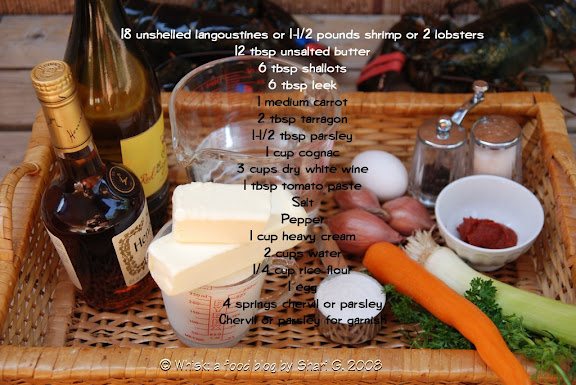
Mise en place for Bisque de Homard (Lobster Bisque)You can find the recipe for Bisque de Langoustins (Langoustine Bisque) {I substituted lobster for langoustines} in the book Le Cordon Bleu at Home (affiliate link). To see how the rest of the Whisk Wednesdays group fared with this week's recipe, click here (or check out the sidebar) and then click on each blogger!

Bisque de Homard (Lobster Bisque)Tasting Notes
“This is the most expensive soup I’ve ever made!” {me}
“This is the best soup I’ve ever tasted.” {sister and mom}
“What a lot of dishes!” {dad}

This soup had a rich, creamy flavor that was smooth and pleasing to the palate. The quenelles that floated on top of the soup provided a different texture and satisfying bite of lobster meat.

A dollar for every sip. Was it worth it?

“A bargain at thrice the price~!” says my mom. {But she’s my mom.} Next time, I’ll use shrimp.
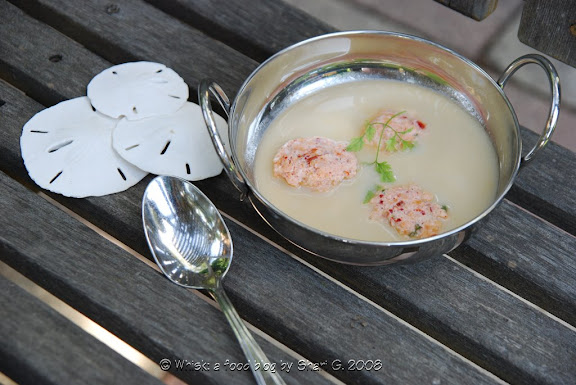
Bisque de Homard (Lobster Bisque)Next Week (August 6)
• Consommé Madrilène (Chilled Consommé with Red Peppers and Tomatoes) pages 267-268

. . . . . . . . . .

Running total: $506.28 + $97.96 ($16.33 per serving!) = $604.24

Butter used so far: 6 pounds, 26 tablespoons

. . . . . . . . . .

Just a note that I'm away for a couple days at a cottage without internet (yikes), so I may not get around to everyone's blogs in the next few days. I promise to catch up when I get back.