Showing posts with label classic French recipes. Show all posts

Monday, May 10, 2010

Cheese Sticks


Pâte feuilletée, or puff pastry, is often considered one of the most challenging yet rewarding doughs to master in the culinary world. Known for its delicate layers that puff up beautifully in the oven, this dough relies on a precise technique to create the "leaves" or layers without the use of yeast. Though made with just three basic ingredients—flour, water, and butter—it demands patience and skill to perfect.

The magic behind puff pastry lies in the layers of butter trapped within the dough. As the dough bakes, the water in the butter turns to steam, causing the layers to separate and rise, creating the signature light, flaky texture. While mastering puff pastry can be tricky, with the right technique and a bit of practice, you can create this stunning dough for all kinds of delicious treats.


The formula for puff pastry:
400 g flour + 200 g water (half the flour) + 300 g butter (flour + water divided by 2) + salt (optional)
Puff pastry's number one enemy is heat. Working quickly, and never doing more than two turns at a time, you must keep the butter cool enough so that it doesn't leak out during rolling.

Recipe: Cheese Sticks

400 g flour
200 g water
6 g salt
300 g butter
100 g Gruyère cheese

You can find the recipe for Allumettes au fromage (Puff pastry strips with cheese) here along with more background information. It was part of Week 2 at Le Cordon Bleu in Basic Cuisine.


Links
Video (in French but shows the technique) 
Eggbeater's Puff Pastry 
50 Flaky, Crunchy, Delicious Appetizers, Entrées (affiliate link)

More to Explore:


Wednesday, August 26, 2009

Whisk Wednesdays—Coquelets sur Canapés (Roast Squab Chickens with Chicken Liver Canapés and Mushrooms)

Coquelets sur Canapés (Roast Squab Chickens with Chicken Liver Canapés and Mushrooms)Squab, a euphemism for a 4-week old, tender nestling pigeon is on the menu this week. I've only fed pigeons, never eaten one so it was a new adventure for me! Along with the squab, I prepared a partridge and a regular chicken for comparison.

The birds were sprinkled with salt, shallots and tarragon, then rubbed all over with butter. Finally strips of bacon (that had been simmered in water for 10 minutes to remove some of its smokiness) were placed on top to add flavor. The poultry were roasted in a 400°F oven until the juices ran clear (about 30-40 minutes).

The mushrooms, canapé and sauce make this roast poultry so much more delectable! The mushrooms are easily sautéed in butter and oil and then set aside. For the canapé, I chopped up some fresh-from-the-garden tomatoes and made a bruschetta using the recipe's ingredients instead of the requested chicken-liver version. Frying the bread slices in clarified butter added extra richness. To deglaze the roasting pan, I used the pan juices, homemade chicken stock, a dash of leftover veal stock and a splash of port and let this mixture simmer until reduced by half. Finished with butter, this sauce was perfect ladled over the meat.

Recipe: Coquelets sur Canapés (Roast Squab Chickens with Chicken Liver Canapés and Mushrooms)

Serves: 6 (I halved the recipe.)

Coquelets sur Canapés (Roast Squab Chickens with Chicken Liver Canapés and Mushrooms) mise en place

Ingredients:

Partridge, Squab, Chicken

For the Mushrooms:
¾ pound fresh mushrooms
½ tablespoon butter
½ tablespoon oil
½ tablespoons shallots, minced
¼ clove garlic, mashed

For the Canapés:
3 slices homemade-type white bread
¼ cup clarified butter
3 poultry or game livers
1½ tablespoons bacon fat
1/8 teaspoon salt
Big pinch of pepper
½ tablespoon Madeira, port or cognac

For the Squab:
3 10- to 12-ounce, ready-to-cook squab chickens
¾ teaspoon salt
1 tablespoon shallots, minced
¼ teaspoon dried oregano
2 tablespoons butter
3 strips of bacon simmered in water for 10 minutes, rinsed and dried
1½ tablespoon butter, melted with ½ tablespoon good cooking oil
¾ teaspoon salt

For the Sauce:
½ tablespoon shallots, minced
¾ cup brown chicken stock or brown stock
1/8 cup Madeira or port
½ to 1 tablespoon butter, softened

For Reheating the Mushrooms:
½ tablespoon butter
1/8 teaspoon salt
Pinch of pepper

For Final Assembly:
Handful of parsley (or sage) for garnish

You can find the recipe for Coquelets sur Canapés (Roast Squab Chickens with Chicken Liver Canapés and Mushrooms) in the book Mastering the Art of French Cooking, Volume I (affiliate link). To see how the rest of the Whisk Wednesdays group fared with their recipe, click here (or check out the sidebar) and then click on each blogger!

Pigeons
Statue just outside the entrance to Central Park in NYC

Tasting Notes
The squab had a meatiness similar to dark chicken meat, but it wasn't gamey as I had expected. It was moist and had a good chew to it. Getting all the meat off the bones of the squab was more work for each bite, but worth it. Surprisingly, the taste of the partridge was not discernible from the chicken. Overall, though, I'd rather eat chicken and feed pigeons!
"Toward a better world I contribute my modest smidgin;
I eat the squab, lest it become a pigeon."
— Ogden Nash
Links
Squab.com
• The Julie/Julia Project

Next Class
• Biscuit de Savoie (Sponge Cake) on pages 33-34

. . . . . . . . . .

Running total: $1,497.55 + $19.76 = $1,517.31
($3.29 per serving)

Butter used so far: 12 pounds, 31 tablespoons

91% complete Basic Cuisine

. . . . . . . . . .

More to Explore:


Friday, July 31, 2009

Crème Caramel


There's a buzz in the food world around Julie and Julia, the movie coming to theatres Friday, August 7. I can't wait to see it. And thanks to Leanne Cusack from CTV News at Noon, I'll get to see a sneak preview.

I met Leanne today to talk about my link to this movie as a featured blog on Sony Picture's official trailer website and to demonstrate a French recipe from the Le Cordon Bleu curriculum that I'm working through. Here is a link to my segment on CTV News at Noon.

I was also on "A Morning Ottawa" with Angie Poirier this morning where I demonstrated both Leek and Potato soup (which will be another post another day) and Crème Caramel.

Live TV is a bit of an adrenaline rush. All of a sudden, the lights are on, the camera is pointed towards you, a host is asking questions about you and your work, you're working through the key points of a recipe, and in no time at all the four to six minutes are up. I'm just thankful for the professionalism of all the hosts who make being on air so much easier.

You can read all about Crème Caramel from this post that I did last year.

Recipe: Crème Caramel

from a New York Times article by Julia Child called "Eat, Memory: Sacré Cordon Bleu!"

Serves: 6

Ingredients:

For the Caramel:
½ cup sugar
¼ cup water

For the Custard:
2/3 cup sugar
2 cups milk
1½ teaspoons pure vanilla extract
2 large eggs
4 large egg yolks

Instructions:

Preheat the oven to 350°F. Bring a kettle of water to boil.

To make the caramel, combine the sugar and water in a stainless steel saucepan. Bring to a boil. When the mixture starts to color, swirl the pan to ensure an even color. When it is deep amber, remove it from the heat and immediately pour it into the molds and swirl to coat the bottom of each mold. Let cool.

To make the crème anglaise, heat milk and vanilla extract in a heavy saucepan over medium heat. Bring mixture to a boil. Remove immediately from the heat and let steep for about 10 minutes.

Meanwhile, whisk the eggs, yolks, and sugar until the sugar dissolves and the mixture is a pale yellow color, about 2 minutes. Continue whisking and slowly drizzle in a bit of the hot milk mixture to temper or warm, the eggs so they won't curdle. Keep whisking and slowly pour in the remaining milk mixture. Pour this mixture into the caramel-lined molds.

Set the molds in a baking dish lined with a paper towel. Fill the baking dish with boiling water so that it comes about two-thirds up the sides of the mold. Bake until the custard sets and doesn't jiggle (and a knife inserted into the center comes out clean), about 40-50 minutes. Let the custard cool in the baking dish. Remove from the pan to finish cooling. Chill in the refrigerator for 3 hours or overnight.

To unmold the custard, run a thin knife around the edge of the mold and invert it on a serving platter.


Wednesday, February 25, 2009

Whisk Wednesdays—Pintadeaux au Chou (Guinea Hen with Cabbage)

Pintadeaux au Chou (Guinea Hen with Cabbage)For the next few classes, we're learning about different types of poultry. Cornish hen is on the menu this week (since I couldn't find guinea hen at the butcher). According to Wise Geek, the term "Guinea hen was used to refer to these small poultry servings but Cornish game hen has become more popular."

The Cornish hen is a plump all-white meat bird. Its original breeder was Alphonsine "Therese" Makowsky. Here is a video explaining the history of the Cornish hen.
"The Makowskys began cross-breeding the Cornish game cocks with various chickens and game birds, including a White Plymouth Rock hen and a Malayn fighting cock, to develop the Rock Cornish game hen — a succulent bird with all-white meat, large enough for a single serving." Link
There is another theory that chicken mogul Donald John Tyson created the Rock Cornish game hen by cross-breeding White Rock hens and Cornish hens in 1965.

Cabbage and Other Vegetables
Again, this recipe calls for many pots. In Saucepan #1, the cabbage is blanched. Mon petit chou. I love boiled cabbage that's then drizzled with butter. Its subtle flavor is very comforting. In this dish, it's blanched and served along with the carrots and onions and plays its supporting role very well.

In Large Casserole #2, the onions are cooked until tender, and then the carrots are added. The cabbage joins the milieu along with a Bouquet Garni and 2½ cups of water and this mixture simmers for about 1 hour.

Poultry
I rinsed and dried the Cornish hens with paper towels and then threw a garlic clove, a thyme sprig, and a bay leaf in each cavity and seasoned them with salt and pepper. After trussing, they were ready for Roasting Pan #3 and a 425˚F oven for about 30 minutes.

Bacon
While the hens were roasting, I prepared the bacon. Although the recipe called for lardons, I used bacon strips. Using Twitter, I asked how people like to cook their bacon and got these answers:
chocolatechic
Bake it.
HighChair
Baking sheet in 400F oven. Nice and crisp and stays straight!
PaniniKathy
I do bacon on the broiler tray in the toaster oven - 12-15 min at 375
HarvardCommon
I like it broiled in the oven. Grease drips off, and makes it "slightly" healthier and usually comes out pretty crispy.
Eat_Real
I always do it on a large sheet pan in the oven at 375 degrees F. Cooks a lot at once and turns out nice and crispy.
kayce_m
my vote is for in the oven on a cooling rack-lined sheet pan (i like crispy, tho, LOL)
astarrynite07
you can also bake bacon too or make it in a non-stick pan without any oil once it's done just place it in a paper towel
judecee
sandwiched between a cast iron skillet and press
brucetraser
here's something I want to try! http://tinyurl.com/a5pvvq
RecipeGirl
I hate all of the grease, so I tend to wrap it in paper towels and microwave it. Not nice & crispy though if you need that.
whatsinyourbox
george foreman grill
Since my oven was taken up with the roasting hens, I used the stove to cook the bacon this time. For this recipe, I cut the slices into 1-inch strips, blanched them in Saucepan #4 (but probably could have reused Saucepan #1 to save on one dish) in boiling water for 1 minute to take away the extra saltiness and drained them in cold water. Then, in Frying Pan #5 I fried them in some butter and oil until they were golden and almost crispy. [I'm not sure I really needed to use the butter and oil since bacon has enough fat on its own.]

Polish Sausage
Polish sausage from Butcher Boy Meats in Regina, Saskatchewan with some dill cream cheese and table water crackers was a staple when I was in university. I haven't been able to find Polish sausage that tastes as good as theirs yet. This sausage was tucked into Sauté Pan #2 along with the vegetables, bacon and hens, and cooked along with everything else for awhile. Once everything had finished cooking (about 20 minutes later), I sliced up the Polish sausage and dinner was ready.

Recipe: Pintadeaux au Chou (Guinea Hen with Cabbage)

Serves: 6

Pintadeaux au Chou (Guinea Hen with Cabbage) mise en place

Ingredients:

1 medium head green cabbage
2 tablespoons vegetable oil
4 tablespoons unsalted butter
1 large onion, sliced
¼ pound carrots, sliced
1 Bouquet Garni
Salt and freshly ground pepper
¼ pound slab bacon, sliced ¼ inch thick
2 guinea hens, 2 pounds each (I used Cornish hens)
2 cloves garlic
2 sprigs fresh thyme or ¼ teaspoon dried
2 bay leaves
2 tablespoons softened butter
¾ pound Polish sausage

You can find the recipe for Pintadeaux au Chou (Guinea Hen with Cabbage) in the book Le Cordon Bleu at Home (affiliate link) or a similar recipe here. To see how the rest of the Whisk Wednesdays group fared with their recipe, click here (or check out the sidebar) and then click on each blogger!

Cornish henTasting Notes
The mixed meat medley was nice. I liked the Polish sausage and bacon coupled with the Cornish Hens, which added extra flavor to this delicate meat. The Cornish Hens were tender and delicious. Because the hens are braised in the pot with all the vegetables with the lid on for the last bit, the skin got soft. Next time I would finish the hens in the oven instead and merge the two dishes at the table. Again, too many dishes to be practical, but tasty all the same.

Next Week (March 4)
• Fricassée de Poulet à l'ail et à la Sauge (Chicken Fricassee with Garlic and Sage) pages 324-325

My Favorite Dish
This week, Michelle from Big Black Dog, who is part of the Whisk Wednesdays group, suggested showing off our favorite dish. Since I started food blogging, food props have become a passion and more fun to shop for than clothes or shoes. Here is my favorite dish which was given to me by my mom. The snowflake dish represents some of my first photos, which were taken on the snowbanks on my back deck last Spring.

Snowflake PlateGifts
Michelle from Big Black Dog, who has an amazing list of chef's tips ready to share, set up a little swap among the participants in Whisk Wednesdays. Here is what I received from Jessica from Have We Met? who lives in Charlotte, North Carolina. I have been eyeing this slate cheese plate at our local bookstore for quite some time and she must have read my mind. The heavy cheese knives are lovely too with their crackled look. Thank you, Jessica!

Cheese Tray and Knives. . . . . . . . . .

Running total: $1,110.03 + $11.01 (hens) + $8.95 (other ingredients) = $1,129.99
($3.33 per serving)

Butter used so far: 9 pounds, 22 tablespoons

. . . . . . . . . .
::Whisk Wednesdays::
We're cooking our way through a cooking school curriculum using the Le Cordon Bleu at Home (affiliate link) cookbook. The "classes" are based on the Le Cordon Bleu curriculum found online and used as a guideline. Not all the items in the curriculum are in the cookbook, but most are. Where the items are not in the book, we try to find a suitable substitution. Find out more here.

. . . . . . . . . .

More to Explore:


Wednesday, September 17, 2008

Whisk Wednesdays—Éstouffade de Boeuf Provençale (Braised Beef Casserole, Provence Style)

Éstouffade de Boeuf Provençale (Braised Beef Casserole, Provence Style)Éstouffade (Es-too-fahd) de Boeuf Provençale or Pot Roast. Which sounds better? The French have a flair for making food sound fancy and delicious. And this dish doesn't just sound delicious, it is delicious.

Éstouffade is a beef stew simmered slowly in a covered casserole dish. The technique is braising, where your goal as "Chef" is to take a cheap, tough cut of meat and make it tender and tasty. Unlike stewing which uses small chunks of meat, braising usually uses a large cut of meat. Turning a hunk of meat into a tender morsel is a bit of magic and science.

A Demo
A few years ago, I attended a demo at Le Cordon Bleu in Basic Cuisine, and it was this class #16 " Les Braisages (Braising)". I casually walked into the classroom before it began, as I have often done for other classes. I and another visitor both found a spot to sit and watched the Chef prepare for the class. I was wondering why the students milling about in the hallway outside weren't coming in, but I realized that at precisely 8:15 a.m., they were allowed to enter and find their seats. Of course, they all addressed the Chef as "Chef" with a capital "C". "Yes, Chef" and "Excuse me, Chef" were heard throughout the morning. I thoroughly enjoyed being a fly on the wall during this demo class. I've enjoyed looking over my notes from that class {after finding them buried under a huge pile of recipes yet to try].

The recipes covered that day were

Boeuf à la mode (Pot-roast)
Carré de porc braisé nivernaise (Braised pork rack with carrots, onions, potatoes and lettuce)
Navarin d'agneau printanier (Braised lamb shoulder stew)

As the Chef prepared the dishes, he talked easily about how lamb is fed, how long it takes to grow a chicken, the use of steroids and antibiotics in poultry, the benefits of organic meat, and occasionally quizzed the students about terminology.

As he was explaining how to butcher meat and the benefits of doing it by hand in your own kitchen, one student bravely asked why he couldn't go to the butcher and buy it already cut. The steely eyes and frustrated tone of the Chef answered him quickly, saying that a chef must be able to do all the food preparation.
"A good chef is worth ten doctors. In Napoleon's army, every captain was a chef."
– So Said the Chef at Le Cordon Bleu that day
Choose the Meat
The meat you select for braising should be one of the leaner, tougher cuts, such as shoulder, shank or chuck. {Save your tenderloin for the grill!} Also, the shank adds more gelatin to the mix so the sauce is thicker at the end of the cooking process.

Beef Cuts
Fatten the Cow
Pork fatback is NOT bacon. I learned this the hard way. I used bacon. It's what I had in the refrigerator. I didn't have pork fatback. I should have gone to a butcher, I know. The bacon added too much flavor to this dish. Go get yourself some fatback, ya hear?

According to Chef, bacon has lots of water in it, shrinks more, and leaves more fat in the pan. {And an over-powering bacon flavor!}

Ok, so if you can't get any fatback, the next best thing is salt pork. It's not bacon either. Even if you get this salt pork, you must blanch it for 10 minutes, rinse, dry {repeat?} to remove all the extra salt they use to cure it.

Before using fatback in the beef, the Chef at the demo class said to marinate the fatback in cognac for 10 minutes. {I wish I'd found my notes before making this!}

Then, you cut the fatback into strips so that you can insert this fat into the lean cut of meat you're about to braise. {Sounds like cheating to me. Or, a better cheat might be to buy a well-marbled piece of meat.} The fat helps to keep the meat from drying out.

Peter Hertzmann has a great article about Boeuf à la mode where he also demonstrates his larding technique and in the end discusses whether or not larding was worthwhile.

Marinate
After adding fat to the lean cut of meat, it gets marinated {for up to 24 hours, if you can, for best flavor}.

The marinade has the usual suspects: onions, carrots and a Bouquet Garni. Tomatoes, garlic, red wine, olive oil and cognac round it out. {You're supposed to turn the meat after 12 hours. Oops. Forgot to do that.}

Braise
Now, it's time to braise. This is a brown braise, where food is browned first (seared) and then dark ingredients, such as red wine, are added.

After straining the marinade in a bowl and setting it aside for later, pat the beef dry so that it can sear. When you sauté the beef, you can add a bit of butter with the oil for extra flavor. Searing caramelizes the outside of the beef and adds more flavor. After it's seared {not burnt!}, drain the fat and set the meat aside to rest. Fry up some bacon. {This time you can use bacon as we all know and love it.} Add the vegetables from the marinade and cook them off until golden. Sprinkle some flour on this mixture and cook for a bit to remove the flour taste. The flour will help thicken the sauce at the end. Then add the strained juice from the marinade — -it's purple! This helps deglaze the pan and pick up all those {burned} bits from the bottom of the pan, called fond.
"…[fond] represents a portion of the essential principles of the roast
fallen from it in the process of cooking."
— Escoffier
Add the meat back into the pan, the tomatoes, the Bouquet Garni, and a bit of salt. The liquid should cover 1/3 of the meat. Add more water if it doesn't meet this stringent braising requirement. Add the vegetables from the marinade back to the pot. Bring to a simmer and then put it in the oven, covered, to finish, slowly. Don't let it boil. The liquid and steam cook the meat slowly until it's very tender. If it's cooked too fast, it will be dry and tough.

I found this great article about braising.

Thicken {or Reduce} the Sauce
"Reduce over medium heat until the sauce thickens slightly."
— from the recipe for Éstouffade de Boeuf Provençale (Braised Beef Casserole, Provence Style)
After taking the meat out and putting it aside to rest a spell, reduce the sauce. As you reduce, you should skim away any fat that comes to the surface. Reducing sounds easy, but I always have trouble with this step — not the skimming but the thickening part. I have to resist the urge to quickly make a roux to thicken the juices. I thought I reduced it enough, but my sauce was runny. Back to the stove to reduce it further, I went {the next day}. After reading these tips, I was prepared to dig out my potato flour to thicken it slightly.

The recipe says to add olives to the sauce {but I didn't}.

Recipe: Éstouffade de Boeuf Provençale (Braised Beef Casserole, Provence Style)
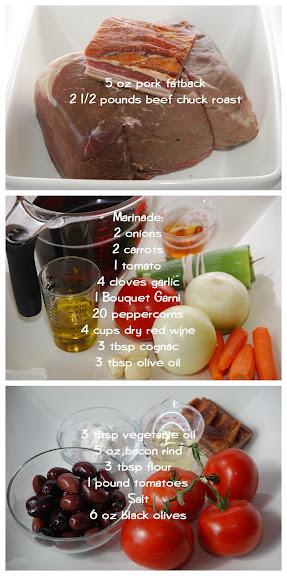
Éstouffade de Boeuf Provençale (Braised Beef Casserole, Provence Style) mise en placeYou can find the recipe for Éstouffade de Boeuf Provençale (Braised Beef Casserole, Provence Style) in the book Le Cordon Bleu at Home (affiliate link). To see how the rest of the Whisk Wednesdays group fared with this week's recipe, click here (or check out the sidebar) and then click on each blogger!

Purple Marinade
The marinade is PURPLE!

Tasting Notes
I made some {well, many} mistakes on this seemingly, easy pot roast. Too bacon-y. Too over-cooked. Sauce was runny. But, everyone enjoyed it, even so, and it was even better the next day. {No anchovies this week! Yay} Next time, I'll try Harold McGee's tip to use a cooler oven (200˚F for the first two hours and then 250˚F for the last hour). I'll also check my butcher for fatback. And, I'll spend more time reducing the sauce. And maybe I'll ask for a Moroccon Tagine for Christmas! That should definitely help!

Next Week (September 24)
• Blanquette de Veau à l’Ancienne (White Veal Stew with Onions and Mushrooms) page 55-56

. . . . . . . . . .

Running total: $752.74 + $21.00 (beef) + $6.46 (marinade) + $4.48 (finishing) = $784.68

Butter used so far: 7 pounds, 27 tablespoons

More to Explore:



Wednesday, August 13, 2008

Whisk Wednesdays—Soupe à l'oignon gratinée (Onion soup)

Soupe à l'oignon gratinée (French Onion Soup) in Onion Bowls Soupe à l'oignon gratinée (French Onion Soup) in onion bowlsI love the smell of onions cooking; it's one of my favorite smells. And French Onion Soup is one of my favorite foods. Although I made it earlier this year, this time I followed the recipe in Le Cordon Bleu at Home which calls for water as the base instead of stock. I found this intriguing since I thought the best onion soup was made with veal or beef stock. In the first taste test, we preferred the French Onion Soup made with beef stock, so I was curious to see if I liked this version.
"Only the pure of heart can make good soup." - Beethoven

"No More Tears" Onions
Getting the onions prepped without tears is hard for some. With my contacts protecting me, I was fine, but my daughter who was my sous chef was crying from the sulfuric compounds in the onion hitting the liquid in her eyes causing sulfuric acid. A tearless onion may be in our future!

After caramelizing the onions in butter for 20 minutes, I added a bit of flour to help thicken the soup a touch. Then, I added the wine, brought it to a boil and simmered for a bit. Finally, I added the water, the Bouquet Garni, and seasoned it with salt and pepper. Then, I left it alone to simmer for awhile.

The Onion Bowl
I had also been wondering if I could make the soup bowl out of an onion, and wouldn't you know it a fellow food blogger did it just this past weekend and blogged about it! I went to the store looking for the largest onions they had, and found big ones, but not huge ones. After scooping out the inside with a grapefruit spoon, I ladled a small amount of warm soup in each onion bowl. I topped each with some toasted bread and cheese. Next, I needed to find out if this onion bowl would hold up under a broiler! And it did!

Links
I found these links helpful:
• a bit of history about French Onion Soup
• a video showing how to make French Onion Soup

Recipe: Soupe à l'oignon gratinée (Onion soup)

Ingredients for Soupe à l'oignon gratinée (French Onion Soup)You can find the recipe for Soupe à l'oignon gratinée (Onion soup) in the book Le Cordon Bleu at Home. To see how the rest of the Whisk Wednesdays group fared with this week's recipe, click here (or check out the sidebar) and then click on each blogger!

Soupe à l'oignon gratinée (French Onion Soup) in onion bowlsTasting Notes
Using an onion as a bowl boosted the flavor of the soup. Although it was more work than using a traditional crock, it was novel, fun, and the perfect size for a small appetizer. It's worth the trouble to impress your guests!

This soup was very flavorful and my favorite of all the French Onion Soup variations I've tried so far. And no stock is required!

Next Week (August 20)
• Potage Ambassadeur (Split Pea Soup with Bacon, Sorrel, and Lettuce) page 462

. . . . . . . . . .

Running total: $633.48 + $5.91 = $639.39

Butter used so far: 6 pounds, 29 tablespoons

. . . . . . . . . .

More to Explore:


Wednesday, April 2, 2008

Salade Niçoise (Vegetable salad Provençale, garnished with tuna, anchovies and egg)

Salade Niçoise (nee-SWAHZ) is a classic salad that seems light but is filling enough to be a main-dish meal. With all the different colored vegetables on the plate, it makes for a beautiful presentation.

Niçoise salad contains tuna and egg as the protein with a ton of vegetables thrown in that are drizzled with a vinaigrette.

Tuna
Instead of canned tuna, I decided to buy a slice of fresh tuna from a local fishmonger. It tastes so much better than canned tuna.

Hard-boiled eggs
I used regular farm eggs, but I checked Thomas Keller's French Laundry Cookbook, and he uses quail eggs. His take on Niçoise salad is unique, as is everything he does. Very inspiring.

Watch a pro hard-boil eggs.

Vegetables
Butter lettuce, green beans, yellow beans, red pepper, yellow pepper, orange pepper, red tomatoes, red potatoes, white potatoes, and red onion. The rainbow of colors makes this salad a thing of beauty. There are other vegetables you can use instead, such as artichokes, cucumber, fava beans, or fennel. Different lettuce can also be used, such as frisée or romaine.

Olives
Of course, Niçoise olives are the ones to use in this salad, but another option from brainchild Thomas Keller is a tapenade, which is a purée of olives, capers, and olive oil.

Vinaigrette
As I learned for the Frisée aux lardons, a vinaigrette is 3 parts oil to 1 part vinegar. Flavorings such as mustard, salt, and pepper are sometimes used. Always whisk the vinegar and flavorings first, and then whisk in the oil. The dressing is usually drizzled over the top or served on the side.

Playing with presentation
Since this salad is part of the “composed” family of salads (or salade composée, in French), it’s a good one to practice food-presentation skills. You can arrange the plate, play with color, and introduce shapes such as rings, hearts or whatever suits your fancy.

Watch a pro
Here’s a video on how to make Salade Niçoise.

Recipe: Salade Niçoise (Vegetable salad Provençale, garnished with tuna, anchovies and egg)


Serves: 2

2 eggs, hard-boiled, cut in half or quarters
1 7-8 ounce slice of tuna (or 7-ounce can)
2 small new potatoes (I used one red and one white for color), cut in half or quarters
Salt
2 ounces green beans
2 ounces yellow beans
5 grape tomatoes, cut in half
½ red, yellow, and orange bell pepper, cut into julienne
¼ red onion, thinly sliced
1 head butter lettuce
2-4 oil-packed anchovy fillets, drained
4-5 black olives (preferably Niçoise or Kalamata), pitted

Vinaigrette:
1½ tablespoons white-wine vinegar
salt and freshly ground black pepper
1½ tablespoons olive oil
3 tablespoons vegetable oil

You can find the recipe in Le Cordon Bleu at Home (affiliate link).

Tasting Notes
This is a simple, but satisfying salad. It’s a fun salad to play around with, but since the ingredients are all so beautiful, it’s hard to go wrong.

. . . . . . . . . .

Running total: $261.55 + $19.87 = $281.42 (That tuna was expensive, but it was worth it!)

Butter used so far: 4 pounds, 19.5 tablespoons

