Saturday, January 9, 2010
Best Waffles
Wednesday, December 30, 2009
Pavlova Cupcakes
Pavlova is like a cloud, with a delicate sweetness and a soft, marshmallowy center. It's the perfect gluten-free dessert for those looking for something light and airy. Whether you serve it with lactaid-laced cream or on its own with fresh fruit, Pavlova is the ideal sweet ending for any meal, especially when catering for gluten-free, lactose-free, and vegetarian guests.
I first experienced this iconic dessert while visiting family friends in Australia. Pavlova has a crisp, crunchy exterior, but a soft, chewy inside that makes each bite irresistible.
Friday, December 25, 2009
Pomegranate Cosmopolitan—A Festive Twist on a Classic Cocktail

The Pomegranate Cosmopolitan is a trendy and delicious variation of the classic Cosmopolitan, popularized in New York City. Known for its pretty pink color, this cocktail is not only easy to make but also classy and fun to serve, making it an ideal choice for festive occasions like Christmas.
While the original Cosmopolitan recipe calls for vodka, Cointreau (or Triple Sec), cranberry juice, and freshly squeezed lime juice, this version uses POM pomegranate juice to add a smooth, rich flavor that tones down the tartness of cranberry juice. The result is a sophisticated, balanced drink that's both refreshing and festive.
The Cosmopolitan has been around since the 1970s, gaining widespread popularity thanks to the hit television series Sex and the City. Known for its connection to Carrie Bradshaw, the Cosmopolitan became synonymous with Manhattan's cocktail culture.
"A cheeseburger, large fries, and a cosmopolitan please."
— Carrie Bradshaw, Sex and the City
Today, the Cosmopolitan is loved worldwide for its vibrant pink color and balanced flavor. The addition of pomegranate juice in this version creates a slightly less sweet, more complex profile, making it a refined and trendy twist on the original.
Recipe: Pomegranate Cosmopolitan
Makes 1 servingIngredients:
Instructions:
- Fill a cocktail shaker halfway with ice.
- Combine all ingredients in a pitcher and pour into the cocktail shaker.
- Shake for 30-40 seconds until well-chilled.
- Pour into a martini glass and garnish with a thin slice of lime.
- Drop a few pomegranate seeds into the glass for an added touch.
- Optionally, ignite some orange zest over the drink to enhance the flavor and aroma of the Grand Marnier.
- Serve immediately and enjoy the festive, refreshing flavors!
The Pomegranate Cosmopolitan offers a balanced and sophisticated flavor profile. The tartness of the cranberry juice is mellowed by the smooth, rich taste of pomegranate juice, creating a more complex cocktail that retains the essence of the classic. Fresh lime juice is essential to achieving the crisp, refreshing finish. Perfect for holiday parties, this cocktail brings a festive twist to the original Cosmopolitan.
Merry Christmas!
More to Explore:
Wednesday, December 9, 2009
Chocolate Kahlua Shortbread

Chocolate Kahlua Shortbread combines the rich flavors of bittersweet chocolate and a splash of Kahlua, creating a festive and indulgent version of the classic shortbread cookie. Perfect for holiday gatherings, these cookies are a melt-in-your-mouth treat that combines a delicate crunch with the sweetness of chocolate and the warmth of Kahlua. This version of shortbread is a favorite Christmas recipe, but it can be enjoyed year-round for any occasion.
Shortbread is a classic cookie that only requires three main ingredients: butter, sugar, and flour. Once those are perfectly mixed together, the possibilities are endless—whether you prefer a traditional shortbread or one with added flavors and decorations. This recipe is one of many delicious twists on a classic favorite.
The first step in making shortbread, and many baked goods for that matter, is creaming the butter and sugar. I thought it was funny when someone next to me in the kitchen at Le Cordon Bleu asked me where the cream was when she heard that we had to "cream the butter and sugar" for the tuiles we were making that day. We all have to start somewhere: some watch a master Michelin-starred chef in a famous cooking school, some hold onto their grandmother's apron stirring batter alongside, and some watch endless hours of the Food Network and are forever scarred by the perfectionism of Martha.
Fat, flour, and sugar. That's shortbread. Mixing these ingredients properly yields a cookie that is slightly crisp, tender, crumbly and melts in your mouth. Beyond these three ingredients, the variations are endless. Some like traditional, plain shortbread. Others like to jazz it up with decorations and flavors. Some like it baked pale, golden or browned. Others roll the dough and cut it into myriad holiday shapes while some use a time-stained shortbread pan.
To me, shortbread means Christmas. A year doesn't go by where I don't make one (or twelve) dozen of this simple cookie. I love how it crumbles in my mouth, the layers shattering and scattering its sweetness. A little taste of chocolate, a hint of Kahlua (maybe I should add more in next year's batch). Another cookie laden with almonds and orange. Another flaked with coconut. It's hard to stop at one. And why should I? It's Christmas. I can be perfect in the New Year!
Recipe: Chocolate Kahlua Shortbread
Makes: about 30 cookiesIngredients:
8 ounces (1/2 pound or 1 cup or 2 sticks) cold unsalted butter, cut into small cubes½ cup sugar
2 cups flour
pinch salt
4 ounces bittersweet or semisweet chocolate, chopped
1 tablespoon Kahlua
Instructions:
- Preheat the oven to 300°F (a low temperature).
- In a stand mixer, beat the butter and sugar until smooth and creamy. You can’t overmix at this stage!
- Sift the flour and salt together onto a piece of parchment paper. This ensures the flour is lump-free and easy to transfer into the bowl.
- Gradually add the flour mixture to the butter and sugar, mixing just until the dough comes together. If the dough feels dry, gently incorporate more room-temperature butter.
- Stir in the chopped chocolate and Kahlua (or skip the Kahlua for a traditional shortbread flavor).
- Turn the dough onto a lightly floured work surface, knead a couple of times to smooth the edges.
- Roll the dough between sheets of wax paper to about ⅜-inch thickness and cut into your desired shapes.
- Chill the dough in the refrigerator for 20 minutes.
- Bake for 20-30 minutes, or until the edges are pale golden.
Variations:
Orange and Grand Marnier:• 1 heaping tablespoon candied orange peel, finely chopped
• zest of 1 orange, grated
• 1 tablespoon Grand Marnier
Cappuccino:
• 1 tablespoon finely ground espresso coffee
• Dip one end of the cookie into melted chocolate
Hazelnut or Almond Orange:
• 1½ cups hazelnuts (skins removed) or almonds, toasted and processed until fine
• 1½ teaspoons finely grated orange zest
Coconut:
• 4 cups sweetened flaked coconut
Other Shortbread Spottings:
• Luna Café: Cranberry, Pistachio & Candied Ginger Shortbread
• Amanda's Cookin': Dorie's Sables
• The Life and Loves of Grumpy's Honeybunch: Peppermint Meltaways
• Eat Yet? alfajores dulce de leche

Tasting Notes
The Chocolate Kahlua Shortbread offers a perfect balance of crisp, tender texture with just the right amount of sweetness. The chocolate adds richness, while the Kahlua imparts a warm, aromatic depth that makes this cookie stand out from your traditional shortbread. One bite is enough to make this cookie a holiday favorite.
More to Explore:
Friday, December 4, 2009
Biscuit de Savoie (Sponge Cake): A French Classic for Any Occasion
Light, airy, and subtly sweet, Biscuit de Savoie is a traditional French sponge cake that melts in your mouth with every bite. With a hint of vanilla, this versatile dessert pairs beautifully with chocolate, fruit coulis, or even a classic crème anglaise. It’s also delightful on its own as a mid-morning treat or a satisfying dessert.When you take a bite, it makes a squishy, bubbly sound. With its hint of vanilla, it adapts well to dipping into chocolate or fruit coulis, but stands on its own as a mid-morning grumble-stopper.
Thursday, November 26, 2009
Kitchen Christmas Wishes
These two blogs list the contents of the knife kit thoroughly, so I won't re-list them here. But I thought I'd list some kitchen tools from the kit along with other items I found useful during my practical classes at Le Cordon Bleu.
Thursday, November 19, 2009
Tuesday, November 17, 2009
Exams are Over
I learned a lot these past three months. About me, about life, but mostly about food.
I know sauces. I know to brown the bones and parure (leftover cuttings from deboning the pork) in hot fat in a sauté pan until they're so brown, but not quite burnt. I know to dégreaser to remove the extra fat. I know how to sauté the onions until they turn color to add more flavor. Then, I know to singer (add flour) to have a thickened sauce in the end. I know to add the alcohol next, the salted white wine (or better yet the good stuff from home) and let it reduce to remove the acidity. Finally, I know to add the rich, dark, brown veal stock. After this, I know to move this mixture to a smaller pan so that the flavors can marry and not evaporate into the busy, stressful kitchen. Skimming often removes the scum and foam, I know this is important. And then I can let it do its magic, thicken and absorb all the flavors from the bones, onions, wine, and stock. In an hour, this sauce is carefully strained and just needs a little kiss of salt, a spoonful of Dijon mustard, a sprinkle of julienned cornichons, and a dash of white pepper (or black pepper at my house). I've learned sauces.
I also know how to butcher...somewhat. Given a small rack of ribs, I can remove them from its clingy backbone and clean the bones (called manchanner). I can even prepare a pretty paper papillotte to hide the unsightly bone from diners' eyes.
But I can't turn vegetables. And under pressure, I can't assemble two plates for presentation without drips and overlapping veg, my shaking hands failing me. Will it be enough?
It's serving time. I'm one minute late. 60 seconds turns into 80, which turns into 90 and my hands get shakier. I can't dig out the finely julienned pickle from the strainer to display on the plate. Why did I strain it? I'd already strained it earlier. I'm flustered and the chef keeps yelling out "serve, serve, serve". Shhh. I need quiet. I need peace. I want my kitchen.
It's just food. Delicious, nourishing food (but the green beans are a little overcooked, my turned carrots are amateur, and why did I let them burn at the end?). The pork chop may have been overcooked (but better to be over than under or it won't even be tasted). My plate is whisked away to another room to be judged by the mouths that be.
I did my best, but it may not be good enough. On Thursday I may get a phone call that says "I'm sorry to tell you that you've failed Basic Cuisine." But I've learned a lot. No matter what the chefs decide, I will remember this quote from Émile Coué: "Every day, in every way, I am getting better and better." For now, I'll enjoy the relief of having it behind me. I'll toast with a glass of wine and likely a shot of Skinos later. And I'll be inspired by Robert Crawford:
Advice
When you are faced with two alternatives
Choose both. And should they put you to the test,
Tick every box. Nothing is ever single.
A seed’s a tree’s a ship’s a constellation.
Nail your true colours to this branching mast.
I will remember to
* dream big
* do all that I can
* grab life
* live big
* say yes
* trust life
* be authentic
* be true
* be strong
* let the wind take you
* you are the mast in the wind, growing stronger every day
It's good advice.
Here is Chef's version of my exam dish: Côtes de porc charcutière, pommes purée (Pork chops with pickle sauce and mashed potatoes):
Recipe for Côtes de porc charcutière, pommes purée (Pork chops with pickle sauce and mashed potatoes)
2 pc Pork Chops
25 ml Oil
Salt & Pepper to taste
Mashed Potatoes
650 g Potatoes
250 g Milk
50 g Butter
Sauce
1 pc Onion
25 g Flour
100 ml White wine
100 ml Thickened brown veal stock
10 g Dijon mustard
15 g Pickles
15 g Butter
Garnish
2 br Parsley
More to Explore:
Thursday, November 5, 2009
Peanut Vermicelli

Peanut Vermicelli is a delightful noodle dish bursting with rich, creamy flavors and a touch of spice. Perfect as a quick side dish or a satisfying main meal when paired with cooked chicken, this recipe combines the nutty goodness of peanut butter with aromatic spices, coconut milk, and tender rice vermicelli noodles.
I once worked beside a little-known, but top-notch take-out café called The Five Senses. Many times a week, I'd wander over at noon to see what the chef was cooking in his kitchen. Even though he worked in the kitchen alone, he was able to create delicious food.
After some tweaking, I've come up with the quantities that I like. It remains a favorite side dish or even a main dish when I add cooked chicken.Recipe: Peanut Vermicelli
Serves: 8Ingredients:
For the Sauce:1 cup peanut butter (chunky or smooth)
1 (14-ounce or 398 mL) can coconut milk
1 teaspoon curry powder
½ tablespoon fresh gingerroot, minced
4 cloves fresh garlic, minced
1 teaspoon lemon juice
3 tablespoons soya sauce
1 tablespoon sesame oil
1 16-ounce package dried rice vermicelli
Peanuts for garnish
Instructions:
To Prepare and Serve Immediately:- Heat all sauce ingredients in a medium-sized saucepan over medium heat. Stir until well-blended and warm.
- Follow the package directions to cook the dried rice vermicelli.
- Combine the cooked vermicelli with the sauce. Garnish with peanuts and serve hot or cold.
To Freeze the Sauce:
- Allow the sauce to cool completely. Transfer to a container or food storage bag and freeze. (Cook the vermicelli fresh when ready to serve.)
- Recommended freezing time: 6-12 months.
To Prepare After Freezing:
- Thaw the sauce overnight in the refrigerator.
- Cook the dried rice vermicelli according to package instructions.
- Warm the sauce, mix with the noodles, and serve.
More to Explore:
Monday, October 26, 2009
Beef Dip

Beef Dip is a hearty and delicious dish that’s perfect for gatherings, weeknight dinners, or whenever you’re craving tender roast beef with savory dipping sauce. The secret? A humble package of onion soup mix adds incredible flavor with minimal effort. (Shh...don't tell the chefs at Le Cordon Bleu! They would want you to make French Onion Soup from scratch and dehydrate it yourself!)
Serve with crusty French bread for the ultimate comfort meal.
Recipe: Beef Dip
from Auntie JoyceServes: 8
Ingredients:
4-pound beef roast1 teaspoon dry mustard
½ teaspoon dried oregano
Salt and freshly ground black pepper
2 tablespoons vegetable oil
2 yellow onions, cut into slices or rings
5 cups water
½ cup soya sauce
1 package onion soup mix
1 garlic clove, minced
Insructions:
To Prepare and Eat Now:
- Preheat your oven to 325°F (163°C).
- Pat the roast dry with paper towels. Rub or sprinkle it with dry mustard, oregano, salt, and pepper.
- In a large roasting pan, heat vegetable oil over medium-high heat. Sear the roast on all sides until browned. Set aside.
- Add sliced onions to the roasting pan and sauté until tender, about 10 minutes.
- Pour in water, soy sauce, onion soup mix, and minced garlic. Stir to combine. Return the roast to the pan.
- Roast in the oven for 2-2½ hours or until the beef reaches your desired doneness:
Extra-rare (bleu)115-120°F (46-49°C)
Rare125-130°F (52-55°C)
Medium rare130-140°F (55-60°C)
Medium140-150°F (60-65°C)
Medium well150-155°F (65-69°C)
Well done>160°F (>71°C)
To Freeze:
- Cook the roast to a slightly lower temperature than desired, allowing it to finish cooking when reheated.
- Slice the beef and layer it between sheets of wax paper.
- Freeze the roast and sauce in separate containers. Recommended freezing time: 6-12 months.
To Prepare After Freezing:
- Thaw overnight in the refrigerator.
- Reheat the beef slices and sauce in the microwave or on the stovetop.

More to Explore:
Thursday, October 22, 2009
Week 5 at Le Cordon Bleu (Basic Cuisine)
Thursday, October 15, 2009
Orange Pumpkin Loaf

This Orange Pumpkin Loaf combines the warmth of pumpkin with the bright, zesty taste of whole orange, peel and all! A recipe straight from the professional kitchens of Le Cordon Bleu, this loaf is packed with seasonal spices, walnuts, and raisins, making it a delightful treat for breakfast, tea time, or dessert. I was in the kitchen at Le Cordon Bleu to practice filleting a Dover Sole and turning mushrooms, and Chef shared a pumpkin loaf with me. It was so delicious, I asked for the recipe.
It uses a whole orange, making it extra flavorful and perfect for this Fall season. Enjoy!
Thursday, October 8, 2009
Week 4 at Le Cordon Bleu (Basic Cuisine)
Last week, we had a seminar on taste! Spending a morning talking about taste was pretty cool! In many little white tubs, lined up in rows, were a variety of different colored liquids. In groups, we were given a container and asked to think of a memory that went along with it. Unfortunately, many of the tubs contained slightly stale versions of the originals, and too often Grandma's lace or even, in some cases, urinal pucks came to mind! Here's what we had to guess: white balsamic vinegar, lavender, truffle, shrimp paste, bergamot, lime, hazelnuts, sesame oil, anise-flavored alcohol, hoisin sauce, cognac, soy sauce, fish sauce, vanilla, port, rum calvados, pear alcohol, tabasco, chili paste. I found it challenging to deconstruct the aromas, but it was fun.
The next demo was all about Les Fonds Blanc et Brun (Brown and White Stocks), the base of sauces in French cuisine. We covered chicken stock, veal stock, tomato sauce (one of the mother sauces), and fish fumet. Our practical was to fillet a whole Dover sole, use the bones to make a fish fumet, and finish with a dish called Filet de sole de Douvres Dieppoise. This dish must include mussels and shrimp to be called Dieppoise. Not a problem. I've cooked mussels before and the shrimp came pre-cooked. However, the whole Dover sole slowed me down. It was the maiden voyage for my filleting knife and my hands with a whole fish. My filleting needed practice, so I attended an extra practice the next day and bought some frozen ones from the local fishmonger. I can happily say that I now know how to fillet a flatfish. I can't say that about turning mushrooms. Even after turning pounds of mushrooms that night, my mushrooms are more "carved" than "turned".
Here are some of the dishes the chef made during the demo.
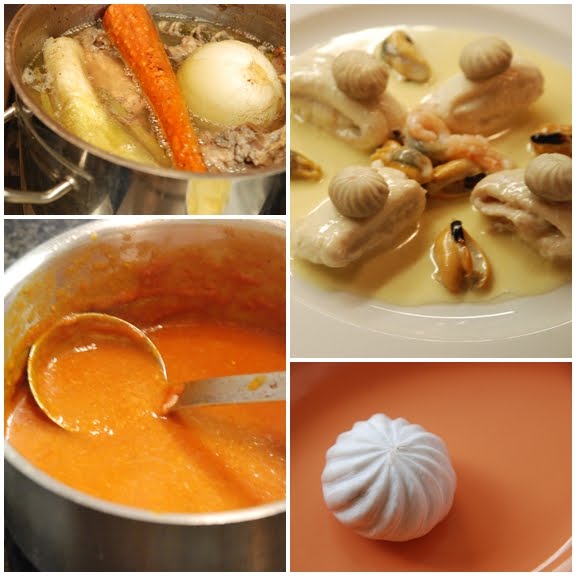
Filets de sole Dieppoise (Sole fillet served with a white wine sauce)
Turned mushroom
Sauce tomate (Tomato sauce)
The next demo discussed two more mother sauces (Espagnole and Béchamel) and their derivatives (demi-glace, Sauce Crème, Sauce Mornay, and Sauce Soubise). Trouble came when it was time to truss the chicken during the practical. It looks easy enough. Cut wing tips. Dig out the wishbone. String needle. Poke through cartilage in one leg, through the other leg, flip, through two bones of one wing, under neck, through two bones of the other wing, and tie. With the leftover string, thread through cartilage in one leg, through the pope's nose, and through cartilage in the other leg and tie the legs together. Tuck wings under. Not so hard. But it was for me. After three tries and each time, the chef shook his head saying "Do it again" in his stern, French accent, tears started to fall. I knew this would happen, but I thought it would be over a burnt sauce or charred meat, not over a simple truss. Meanwhile, the other students were getting their chicken broth cooking, but I was still bent over my string with salty tears brining my naked bird. Finally, I plopped my tear-stained and weakly tied bird into the pot and hid it with water hoping I could catch up. Unfortunately, I also seemed to pick the station where the flame kept going out under my pot. This bird did not want to get cooked.
I made my roux and checked it with the chef who with a slight air said I'd added a touch too much butter for the amount of flour. Then, it was onto the rice pilaf. The onions had to be cut in ciseler fashion and were to be the size of a grain of rice. Some were; some weren't. I sweat the onions in butter making sure they didn't acquire any color, then added the rice and cooked until nacré (a pearl color!). A bit of salt, a bouquet garni, the right amount of water, and a lid of parchment paper, and into the oven for exactly 17 minutes.
Back to the chicken. Checking it confirmed my fears: it wasn't cooked yet. And for some reason, I didn't think to remove some of the broth to reduce separately for the sauce. I turned my attention to the roux and mistakenly added the cream before adding the broth, ruining both in the process! This was not my day. So, I was back to making a new batch of roux. I quickly measured 30 grams of flour and butter and hastily set about to cooking it to the required blond, nutty color. By this time, I had the forethought to put some broth in a separate pot to reduce. When the roux was ready, so was my broth. I added it to my roux, thickened the mixture, and let it cook for as long as possible before adding the cream. Everything else came together. My sauce was à la nappe, coating the chicken, my bird was cooked just right (not a second more), and my rice was done with the odd large piece of onion thrown in. And the tears buried in my chicken earlier made it taste even better.
Here are two of the dishes the chef made during the demo.
Poulet poché sauce Suprême (Whole poached chicken served with a white creamy sauce)
The final demo last week was about emulsion sauces including hollandaise and Béarnaise. I love these two rich sauces. The first step in the Béarnaise is a reduction. Easy enough, but you need enough liquid after the reduction to make the sabayon. For the sabayon, which contains two yolks, you need two half-egg shells full of liquid. I thought I had enough, but it became apparent while whisking my sabayon that I was lacking a few drops! The chef came over, frowned, went to the sink dribbled a few more drops of water expertly in my bowl, and warned that it might break on me in no time flat. I whisked and whisked and whisked. Although it never broke, it was a little thick. Again, when the chef came over, and saw me whisking in the clarified butter on the "cold" side of the station, he grimaced and suggested I move to the stove side, again warning that my sauce would break and that it was saturated with butter! Funny because I had started clarifying more butter since I didn't have as much as the recipe called for. We also had to turn some potatoes à l'Anglaise (a specific size that is three fingers long) and grill some salmon. Again, I finished on time, but a critique of my plate was all critique. School is tough, but I'm learning a ton, even through my tears.
Here are some of the dishes the chef made during the demo.
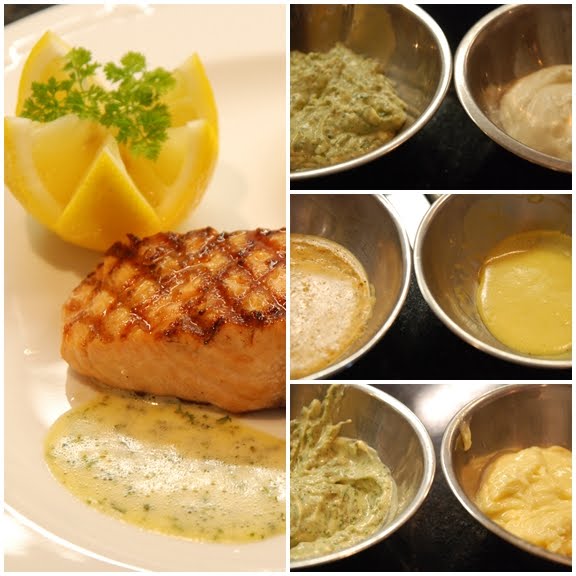
Sauce Rémoulade (Sauce derived from Mayonnaise) & Hollandaise
Sauce Tyrolienne (Béarnaise sauce made with oil) & Sauce Moutarde (Sauce derived from Hollandaise)
Sauce Grebiche (Emulsified cold sauce based on cooked egg yolk) & Mayonnaise
. . . . . . . . . .
Here is a link back to the recipes as I did them last year (although they aren't exactly the same as what we did in class):
Class 10: Les Fonds Blanc et Brun (Brown and White Stocks)
Fumet de poisson (Fish stock)
Filets de sole Dieppoise (Sole fillet served with a white wine sauce)
Fond blanc de volaille (Basic recipe for white stock)
Fond brun clair de veau (Basic recipe for brown stock)
Sauce tomate (Tomato sauce)
Class 11: Les Sauces et Liaisons (Mother Sauces and Liaisons)
Poulet poché sauce Suprême (Whole poached chicken served with a white creamy sauce)
Sauce Espagnole and Demi-glace (Basic brown sauces)
Sauce Béchamel (White sauce): Crème, Mornay, and Soubise
Class 12: Les emulsions (Emulsion sauces)
Sauce Hollandaise (Warm emulsified sauce) and Sauce Moutarde
Sauce Béarnaise (Warm emulsified sauce derived from Hollandaise sauce)
Sauce Mayonnaise (Basic emulsified sauce) and Salade Messidor (Summer Harvest Salad)

More to Explore:
Wednesday, October 7, 2009
Whisk Wednesdays—Beignets aux Pommes, Sauce Abricot (Apple Fritters with Apricot Sauce)
This recipe completes my goal of working through the Basic Cuisine curriculum on my own, in my own kitchen. I started my blog as a way of documenting my progress working through this Le Cordon Bleu curriculum, not knowing that I'd actually be attending 20 months later!Thursday, October 1, 2009
Fresh Pasta
One of my favorite kitchen gadgets is my KitchenAid Stand Mixer (affiliate link). I’ve thrown some tough dough its way and it has yet to fail me. Recently, I was pleased to receive the pasta attachment as a gift. The KitchenAid Companions Gourmet Pasta Kit came with the following items:• a metal pasta roller
• a metal fettuccine cutter
• a pasta server and slotted spoon
• two boxes of Ecco La Pasta flour (egg and spinach)
• a cleaning brush
The timing of this gift was fantastic since we had just covered fresh pasta dough in Lesson 6 at Le Cordon Bleu and practicing making pasta at home was the perfect way to test out this attachment.
Now, in the Basic Cuisine course, no kitchen machinery is allowed and all work must be done by hand to develop a sense for the feel of the dough at various stages. So I decided it would be fun to do a "bake off" so to speak: half of the pasta I hand rolled and cut and the other half I made using the mixer attachment. As an extra experiment, I made one batch with just yolks (and added extra water) and the other with whole eggs. The chef had suggested we try this to see if we preferred one dough over the other.
Using the attachment was twice as fast as without. Within the hour, I had fresh pasta ready for lunch. Not only that but it was easy enough to use that my 10-year-old daughter quickly figured it out and had fun putting the dough through, each time moving the dial to a thinner setting appropriate for fettucini. Hand rolling took a lot of effort, but eventually, after much rolling, I rolled it to the proper thickness. My daughter found it difficult to get it thin enough, so I helped her. Even so, our dough was uneven and squaring it off to cut even lengths meant re-rolling. Though not impossible to hand roll, we both preferred the attachment, which makes pasta making a breeze.
As far as the eggs are concerned, no one could taste a difference between the two so I would use whole eggs next time, just for the sake of convenience.
All in all, we're looking forward to making more pasta and using the roller to make lasagna noodles (a family favorite). Clean-up was also easy! My daughter just wiped it with a cloth and used the small brush to get any bits out. She was so pleased with her homemade pasta that she took it to school the next day in her lunch. With this pasta-making attachment, I'll be making homemade pasta often! Or maybe my daughter will be making it for me!
Recipe: Fresh Pasta
Serves: 6
Ingredients:
Instructions:
1. Prepare the Dough:
- Sift the flour onto a clean countertop. Whisk in the salt. Create a well in the center.
- Add olive oil, eggs, and water into the well. Using your fingers, gradually mix the wet ingredients while slowly incorporating the surrounding flour to form a paste.
- Once the mixture becomes crumbly, use a pastry scraper to gather and knead it into a smooth dough. Add extra olive oil or water if the dough feels dry.
2. Rest the Dough:
- Wrap the dough in plastic wrap and let it rest in the refrigerator for 20 minutes. This step ensures elasticity and easier rolling.
3. Rolling the Dough:
- By Hand: Roll the dough to a 1–2 mm thickness with a rolling pin. Square the edges with a knife, then fold the dough into even layers (approximately 5 cm wide). Slice into fettuccine strips and dust with flour to prevent sticking.
- Using KitchenAid Attachment: Attach the pasta roller and start at the widest setting. Pass the dough through, folding it in half and repeating until smooth. Gradually reduce the roller thickness to the desired setting. Use the fettuccine cutter attachment for even strips.
4. Cooking the Pasta:
- Boil a large pot of salted water. Cook the pasta for 3–5 minutes, or until al dente. Drain and serve immediately with your favorite sauce.
Tasting Notes
Freshly made pasta offers a soft, silky texture that elevates any dish. Whether hand-rolled or made with a KitchenAid attachment, the difference in flavor and quality is unmistakable. Pair with a classic tomato sauce or creamy Alfredo for a satisfying meal.
More to Explore:



